1. Volumetric Analysis
🎯 Learning Outcomes
After the completion of the lesson, the students should be able to
- Define and explain the terms volumetric and gravimetric analysis.
- Define and calculate equivalent weights of (elements, acids, bases, salts, oxidising and reducing agents)
- Define, express, and calculate the concentration of solutions in terms of percentage, g/l, molarity, molality, normality, formality, ppm, and ppb
- Explain and apply the concept of the law of equivalence and the normality equation in chemical calculations.
- Define, describe, explain, and distinguish primary and secondary standard substances.
- Explain different types of titrations and their applications.
- Define terms related to volumetric analysis, such as standard solution, normality factor, equivalence point, endpoint, indicator, and redox titration, etc.
- Solve numerical and higher-level problems related to concentrations, dilutions, and titrations
🧪 Chemical Analysis▶
Imagine a doctor prescribing a medicine dose, a water-treatment plant monitoring fluoride levels, or a food scientist checking the acidity of fruit juice. In each case, it is important to know not only which substances are present but also how much of each is present.
This is the purpose of chemical analysis—the systematic process of identifying substances and determining their quantities.
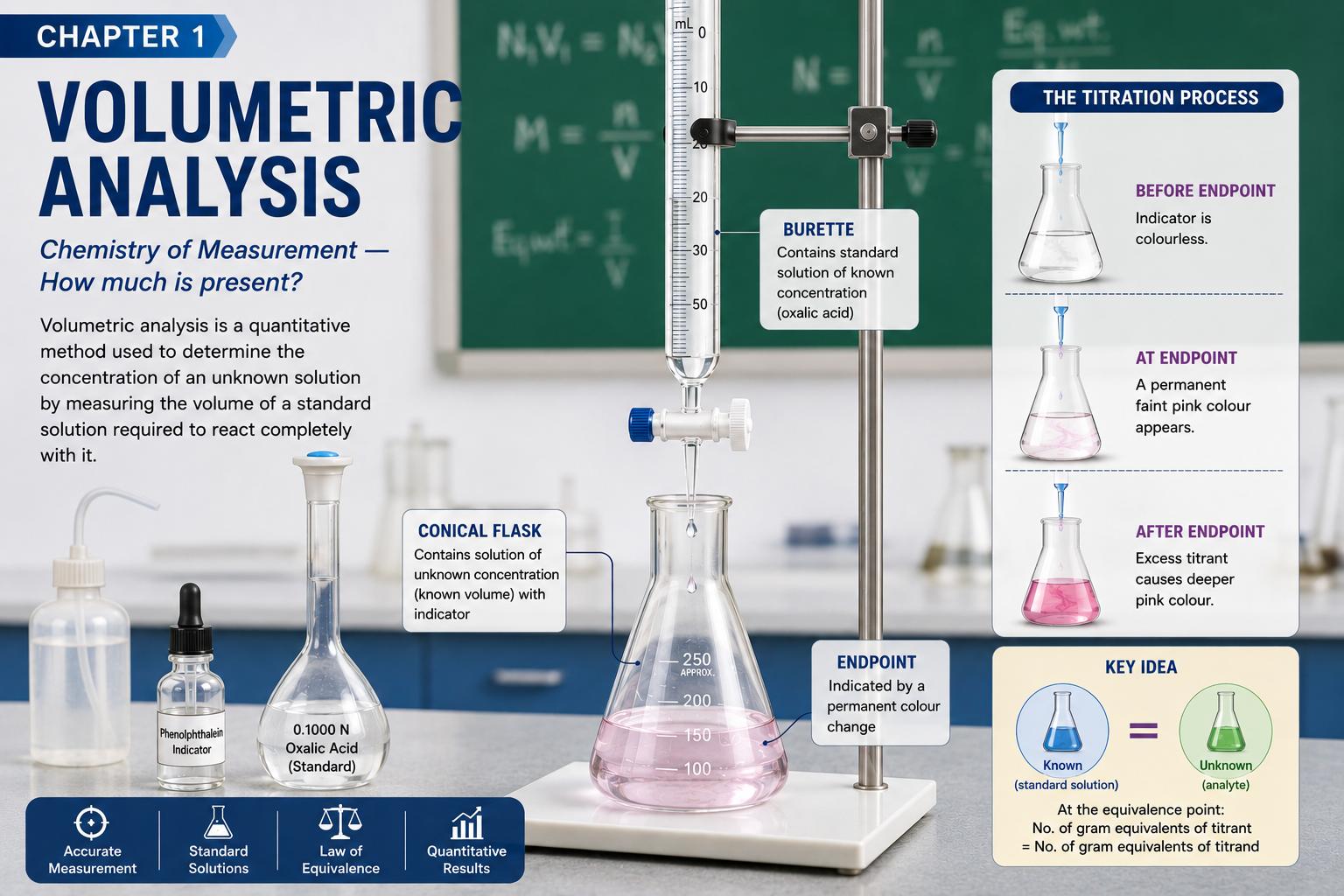
One of the most important methods of quantitative chemical analysis is volumetric analysis, which uses the volume of a solution of known concentration to determine the concentration of another solution. In this chapter, you will learn how to determine unknown concentrations accurately using common laboratory apparatus.
Chemical analysis is of two types
- Qualitative analysis mainly refers to detecting ions or radicals, generally in salts.
- Quantitative analysis determines the quantity of a particular constituent present in a substance.
| Qualitative Analysis | Quantitative Analysis |
|---|---|
| Identifies what substances are present e.g., detection of ions, radicals | Determines how much is present e.g., estimation of iron, chloride ions |
Gravimetric and Volumetric Analysis
Gravimetric Analysis:
- Gravimetric analysis is a quantitative analytical method in which the amount of a substance is determined from an accurately measured mass.
- In precipitation gravimetry, the substance is converted into a suitable precipitate, which is filtered, dried or ignited, and weighed.
- The substance to be analysed is converted into an insoluble precipitate.
Involves: Precipitation → Filtration → Drying → Weighing
Simple and inexpensive method.
Volumetric Analysis: Volumetric analysis is a method of determining a solution’s concentration by finding the volume which exactly reacts with a fixed volume of another standard solution.
| Method | Based on | Process | Example |
|---|---|---|---|
| Gravimetric analysis | Mass measurement | precipitate → filter → dry → weigh | BaSO₄ precipitate from BaCl₂ + H₂SO₄ |
| Volumetric analysis | Volume measurement | Titration using a burette & a pipette | Acid-base titration (HCl + NaOH) |

⚖️ Equivalent Weight▶
Equivalent weight is a concept that tells us how much of a substance reacts with a standard reference amount. It is a bridge between mass and chemical reactivity.
1. Equivalent Weight of an Element
It is the number of parts by weight of that element, which combines with or displaces directly or indirectly 1.008 parts by weight of hydrogen, 8 parts by weight of oxygen, or 35.5 parts by weight of chlorine.
Equivalent weight is expressed in g/equiv. In numerical calculations, it is often treated simply as a numerical value without a unit.
The relation between Equivalent weight (E), atomic mass (A), and Valency (V) of an element
Consider an element with equivalent weight ‘E’, atomic mass ‘A’, and valency ‘V’.
By the definition of valency,
An atom of the element combines with V atoms of hydrogen.
Or, V atoms of hydrogen combine with one atom of the element
Or, V × 1.008 parts by weight of H combines with A parts by weight of the element.
Or, 1.008 parts by wt. of H combines with A/V parts by wt. of the element.
Now, from the definition of equivalent wt.,
2. Equivalent Weight of Compounds
a. Equivalent weight of acid
Equivalent weight of an acid is defined as the number of parts by weight of an acid that can supply 1.008 parts by weight of hydrogen ions. In other words, it is the ratio of the acid’s molecular mass to its basicity.
Basicity: no. of moles of H⁺ ions that 1 mole of the acid can furnish.
e.g.;
| Acid | Basicity | Molecular wt. | Eq. wt. |
|---|---|---|---|
| H2SO4 | 2 | 98 | 98/2 = 49 |
| (COOH)2.H2O | 2 | 126 | 126/2 = 63 |
Calculate the molecular weights, find basicity and determine the equivalent weights of: CH₃COOH, HCl, HNO₃, and H₃PO₃
b. Equivalent weight of base
Equivalent weight of a base is defined as the number of parts by weight of a base that can neutralise 1 gram equivalent of acid. It is the ratio of molecular mass to acidity.
Acidity: no. of moles of H⁺ ions that 1 mole of the base can neutralise
| Base | Acidity | Molecular wt. | Eq. wt. |
|---|---|---|---|
| NaOH | 1 | 40 | 40/1 = 40 |
| CaO | 2 | 56 | 56/2 = 28 |
Calculate the equivalent weights of: Ca(OH)₂, NH₄OH, KOH, and CaO
c. Equivalent weight of salt
Equivalent weight of salt is defined as the ratio of the molecular weight of salt to the total no. of +ve or –ve charges.
| Salt | +ve or –ve charge | Molecular wt. | Eq. wt. |
|---|---|---|---|
| NaCl | 1 | 58.5 | 58.5/1 = 58.5 |
| Al2(SO4)3 | 6 | 342 | 342/6 = 57 |
Calculate the equivalent weights of the salts: Na₂CO₃, CaCO₃, KCl, AlCl₃ and CaO
d. Equivalent weight of oxidising and reducing agents
Equivalent weight of oxidising and reducing agents is the ratio of the molecular weight to the total change in oxidation number (total electrons lost or gained) during the chemical reaction.
Here, the denominator (Basicity, Acidity, Total Charge, or ΔON) is collectively called the n-factor.
Equivalent weight depends on the particular chemical reaction. It is calculated by dividing the molar mass by the appropriate n-factor for that reaction:
a. Equivalent weight of KMnO₄:
i) In an acidic medium:
ii) In basic medium:
[Copy the above reaction, show all the oxidation numbers, then calculate the total change in oxidation number per molecule.]
iii) In neutral medium:
[Calculate yourself from the given reaction.]
Equivalent weight of reductants: C₂H₂O₄, FeSO₄, Mohr’s salt (FeSO₄.(NH₄)₂SO₄.6H₂O) etc.
a. Equivalent weight of oxalic acid:
For oxalic acid crystals – H2C2O4.2H2O
b. Equivalent weight of Mohr’s salt:
In Mohr’s salt, the reducing agent is Fe²⁺, which is oxidised to Fe³⁺ as:
Or, Fe+2 → Fe+3 + e–
In other words, Fe²⁺ loses one electron; the n-factor for Mohr’s salt is 1.
3. Number of Gram Equivalents
Equivalent weight is mainly used in stoichiometric and volumetric calculations; in practice, we generally work with gram equivalents.
Gram equivalents is the ratio of the weight of the substance in grams to the equivalent weight.
Gram equivalents connect mass to chemical reactivity.
How many gram equivalents are in 20 g of NaOH?
Solution:
Molecular wt. of NaOH = 23+16+1 = 40; acidity = 1 (no. of OH⁻ ions in 1 molecule)
Equivalent weight of NaOH = 40/1 = 40
Gram equivalents = 20 ÷ 40 = 0.5 gram equivalents
🧫 Concentrations▶
- Concentration is the amount of a solute present in a definite quantity of the solution.
- A solution of known concentration is called a standard solution, whereas a solution of unknown concentration is called an unknown solution.
- The concentration of a solution is usually expressed in terms of Normality or Molarity in volumetric analysis. However, the concentration can also be expressed in percentage, grams per litre, formality, mole fraction, etc.
a. Gram per litre
It is defined as the amount of a solute in grams present in one litre of solution.
b. Normality
No. of gram equivalents of solute dissolved in a litre of solution.
Number of gram equivalents = mass in grams / equivalent wt.
Wt. in gram (of solute) = NEV1000 — This last formula is useful to prepare standard solutions.
When one gram equivalent weight of solute is present in one litre of solution, it is called a Normal solution. (1N or N solution)
When half a gram equivalent weight of solute is present in one litre of solution, it is called a SemiNormal solution. (0.5N solution)
Try to define Decinormal (0.1N or N/10) and Centinormal solutions correspondingly.
1. What mass of Na₂CO₃ is required to make 50cc of its seminormal solution?
Solution:
Na₂CO₃ can be considered a base. In the above neutralisation reaction, we can see that 1 mole of it neutralises 2 moles of H⁺ ions. Hence, its acidity is 2.
Now,
vol in ml = 50 ml(cc) normality = 0.5N
molecular wt. = 23 × 2 + 12 + 16 × 3 = 106 amu eqv wt. = molecular wt./acidity = 106/2 = 53
no. of gm eqvs = wt. in gm/53
We know,
normality = no of gram equivalents × 1000/volume in ml
0.5 = wt. in g/53 × 1000/50
wt. in g = 0.5 × 50 × 53/1000 = 1.325 g
Or, use the following formula directly,
N = wt. in g/E × (1000/V) OR, Wt. in gram (of solute) = NEV/1000
Normality Factor (f)
Normality factor (f) tells how the actual concentration of a prepared solution compares with its intended concentration.
The ratio of the weight taken of the solute to the weight to be taken is called the normality factor.
Hence, Actual Normality = Given Normality × Normality factor
It saves time by eliminating the need for exact weighing while giving the actual concentration.
To prepare N/10 Na₂CO₃, you need 5.30 g but actually weigh 5.36 g.
f = 5.36 ÷ 5.30 = 1.011
Actual normality = 0.1 × 1.011 = 0.1011 N
c. Molarity (moles per litre)
A solution’s Molarity (M) is the number of moles of solute dissolved in one litre of solution.
[Write the formula of molarity and express it in different useful forms, with the help of the corresponding formula of normality]
If the solution contains 1 mole, 1 gram-mole, or 1 gram-molecular weight of solute in 1 litre of its solution, then it is called a molar solution, or 1 M or M solution.
[Define semimolar, decimolar and centimolar solutions.]
Relation between Normality and Molarity
We have,
Or, g/L = Normality × Eq. weight …(1)
Similarly,
Or, g/L = Molarity × Molecular Weight …(2)
From equations (1) and (2)
Normality × eq. weight = Molarity × mol. Weight …(3)
But,
Or, Molecular weight = eq. weight × acidity or basicity …(4)
From equations (3) and (4),
Normality × eq. weight = molarity × eq. weight × acidity or basicity
Or, Normality = Molarity × acidity or basicity …(5) for acids and bases
For salt,
Normality = Molarity × No. of +ve or –ve charges …(6)
For oxidising and reducing agents,
Normality = Molarity × Total change in O.N. …(7)
Which is more concentrated? 1 M HCl or 2 M HCl; Obviously 2 M.
Then:
Which is more concentrated? 1 M H₂SO₄ or 1 N H₂SO₄
d. Percentage
(This formula is applicable for %(w/v) or dilute solutions (density ~ 1 g/mL), & mostly percentage is given as w/v)
2. Calculate the Molarity of a 5% H₂SO₄ solution.
Solution:
5% (w/v) H₂SO₄ means 5 g H₂SO₄ in 100 mL solution. So,
Given,
wt. of H₂SO₄ = 5 g; vol. of solution = 100 ml
molecular wt. of H₂SO₄ = 1 × 2 + 32 + 16 × 4 = 98
We know,
Molarity = no of moles × 1000/vol in mL
Molarity = wt. in grams/molecular wt. × 1000/vol in mL
= 5/98 × 1000/100 = 5/98 × 10 = 50/98 = 0.5102 M
e. Molality
Moles of solute per kg (1000g) of solvent. Unlike molarity, molality doesn’t change with temperature.
Molarity depends on volume, and volume can change with temperature. Molality depends on the mass of solvent, which does not appreciably change with temperature.
f. Formality
Since ionic compounds like NaCl do not exist as discrete molecules in solution, we use ‘formula weight’ instead of ‘molecular weight’, and its concentration is expressed as Formality.
g. ppm (parts per million)
ppm = (mass solute/mass solution) × 10⁶
h. ppb (parts per billion)
ppb = (mass solute/mass solution) × 10⁹
ppm and ppb units are used for very dilute solutions, such as pollutants in water or trace metals in blood.
The safe limit for arsenic in drinking water, as set by WHO, is 10 ppb (micrograms per litre). Volumetric and instrumental methods help analysts measure these incredibly small concentrations — protecting millions of people from arsenic poisoning.
i. Mole fraction
📏 Primary & Secondary Standard Substances & Solutions▶
Standard solution: A solution of known concentration is called the standard solution. It is of two types;
1. Primary standard solution:
The solution whose concentration is known and prepared by dissolving a suitable amount of primary standard substance in a solvent of definite volume is called a primary standard solution.
E.g., N/10 Oxalic acid solution, 1N Mohr’s salt solution, N/2 Na₂CO₃ solution, etc.
2. Secondary standard solution:
The solution whose concentration is known by standardising it with the primary standard solution is called the secondary standard solution.
E.g., N/10 HCl solution, N/20 H₂SO₄ solution, N/10 KMnO₄ solution etc.
NaOH, HCl, and H₂SO₄ are NOT primary standards. NaOH absorbs CO₂ and moisture from the air; HCl and H₂SO₄ fumes make accurate weighing impossible
Requirements for a Primary Standard Substance:
- Available readily in a very high purity.
- Stable (not reactive to the atmosphere), non-hygroscopic
- The composition of the substance should not change in the solid state or solution state for a sufficiently long time.
- It should have a high equivalent wt./molecular wt., so that the relative weighing error is minimum.
- Non-toxic and readily soluble in the given solvent under the employed conditions.
Examples: Na₂CO₃, (COOH)₂.2H₂O, Mohr’s salt FeSO₄.(NH₄)₂SO₄.6H₂O
A standard Na₂CO₃ solution is used to standardise HCl because HCl is not a primary standard.
Oxalic acid is used to standardise KMnO₄.
Primary standard → weigh accurately → prepare solution directly.
Secondary standard → concentration determined by standardisation.
⚗️ Law of Equivalence and Normality Equation▶
Usually, the concentration of the given solution is expressed in terms of Normality.
The volume and strength of a given solution can be mutually changed. If the volume is decreased, the strength must be increased proportionally, and vice versa. (Volume and Normality of the same solution are reciprocals of each other) E.g.;
100 ml of 1N HCl = 1 ml of 100N HCl
= 10 ml of 10N HCl
= 1000 ml of 0.1N HCl
So, X ml of YN solution = (X.Y) ml of 1N solution
An equal volume of acid solution neutralises an equal volume of a basic solution of the same strength. (1 gram equivalent of an acid solution can neutralise 1 gram equivalent of alkali solution) E.g.;
1 gm. Eq. of HCl = 1 gm. Eq. of NaOH
35.5 gm of HCl = 40 gm. Of NaOH
1000 ml of 1N HCl = 1000 ml of 1N NaOH
1 ml of 1N HCl = 1 ml of 1N NaOH
At the equivalence point,
No. of gram equivalents of acid = no. of gram equivalents of base
We know that
Normality = no. of gram equivalents/volume in litres
So,
No. of gm eqv. = vol. in liter × normality
Therefore,
vol. of acid in litres × Normality of acid = vol. of base in litres × Normality of base
Where,
V₁ = Volume of acid N₁ or S₁ = Strength of acid
V₂ = Volume of alkali N₂ or S₂ = Strength of alkali
This equation is called the Normality equation.
The equation M₁V₁ = M₂V₂ applies to dilution problems (not titration).
In titration, use N₁V₁ = N₂V₂. In dilution, use M₁V₁ = M₂V₂ (or N₁V₁ = N₂V₂).
🚨 Do Not Confuse
| Dilution | Titration |
|---|---|
| No chemical reaction | Chemical reaction occurs |
| Same solute | Usually two reacting substances |
| M₁V₁ = M₂V₂ | N₁V₁ = N₂V₂ |
| Concentration changes | Unknown concentration is determined |
🧴 Titration▶
Titration is a technique in which a solution of known concentration (the titrant) is carefully added from a burette to a measured volume of another solution (the titrand) in a conical flask until the completion of the reaction (endpoint), which is signalled by a colour change of an indicator.
The process is repeated until concurrent (more accurately called concordant) readings are obtained.
- ✓ Titrant
- A solution, generally taken in a burette.
- ✓ Titrand
- A solution, generally taken in a conical flask. (In a typical titration, the titrant has a known concentration and the titrand has an unknown concentration.)
- ✓ Indicator
- A substance added, to show the completion of a reaction by colour change.
- ✓ Endpoint
- Completion of titration/reaction as indicated by the indicator.
- ✓ Concurrent (concordant) reading
- The two or more similar consecutive readings obtained during titration.
Types of Titrations
1. Acid-Base titration
- A titration involving a reaction between an acid and a base.
- Used for determining the concentration of an acid by titrating it against a standard alkali solution and vice versa.
- Acidimetry: Determining acid strength using a standard alkali.
- Alkalimetry: Determining alkali strength using a standard acid.
Na+ + OH– + H+ + Cl– → Na+ + Cl– + H+ + OH–
H+ + OH– → H2O
2. Redox titration
Involves oxidation & reduction (electron transfer) reactions. Here, one species loses an electron; another species gains it.
If the colour change of one of the reactants takes place at the endpoint, it’s called a self-indicator.
E.g., the reaction between acidified KMnO₄ and oxalic acid solution, where KMnO₄ acts as a self-indicator (the pink colour of KMnO₄ gets discharged)
(Pink) (Colourless)
The endpoint is indicated by the appearance of a permanent pale pink colour due to a slight excess of KMnO₄.
KMnO₄ – Oxalic Acid Titration: An Overview
| Property | Detail |
|---|---|
| Type | Redox |
| Titrant | KMnO₄ |
| Titrand | Oxalic acid (primary standard) |
| Medium | Acidic |
| Acid | Dilute H₂SO₄ |
| Indicator | KMnO₄ (self-indicator) |
| Endpoint | Permanent pale pink |
| n-factor of KMnO₄ | 5 (ON change of Mn: 7→2) |
| Equivalent weight | 158/5 = 31.6 g/equiv |
| Warming | To increase reaction rate |
3. Iodimetry
Direct titration using iodine as the titrant.
4. Iodometry
Indirect determination of an oxidising agent by liberating iodine from iodide and titrating the iodine, commonly with sodium thiosulfate.
5. Argentometric titration
Using Ag⁺, commonly for halide ions
6. Complexometric titration
Based on formation of a stable complex, commonly using EDTA (for metal ions)
🏁 Endpoint, Equivalence Point, and Neutral Point▶
The completion of a reaction, as indicated by the indicator, is called the endpoint.
The point at which the equivalent quantity of the titrant is added to the titrand is called the equivalence point or theoretical endpoint.
| Aspect | Equivalence point | End point |
|---|---|---|
| Definition | The point in the titration at which an equivalent quantity of titrand is exactly neutralised by titrant. | The point at which the indicator shows that the titration should be stopped, usually by a permanent colour change. |
| Visibility | Not visible in acid-base titration involving a burette and pipette system. | Visible in acid-base titration using a burette and pipette system. |
| Determination method | Determined by using instrumental methods. | Determined by observing the colour change of an indicator in the solution. |
| Reaction completion | The exact point where the reactants are completely reacted. | The practical point at which the completion of the reaction is indicated by the colour change. |
Ideally, the endpoint should be very close to the equivalence point.
For strong acid-strong base titrations, the equivalence point, endpoint (with a suitable indicator), and the neutral point (pH 7) are practically the same.
Equivalence point = reaction says “complete.” Endpoint = indicator says “stop.”
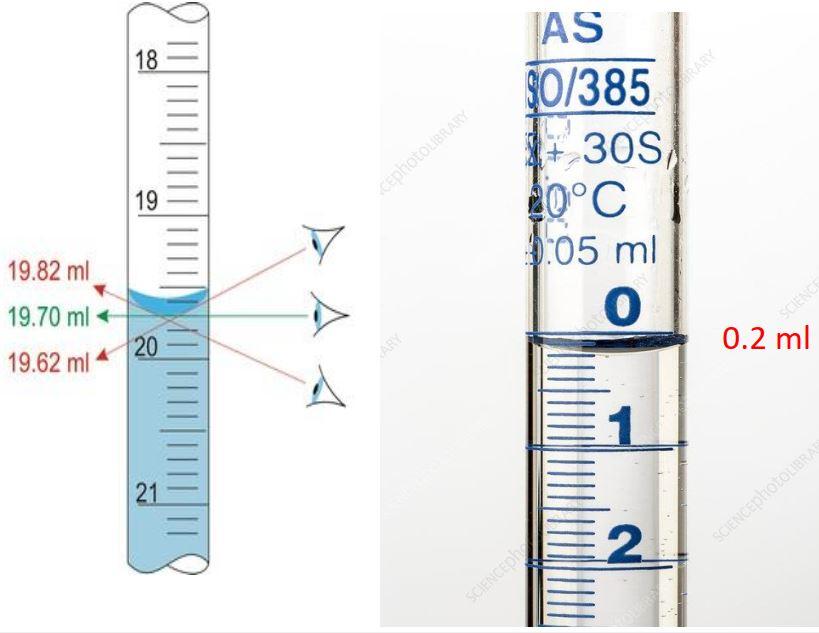
- Parallax error (eye-level reading)
- Overshooting the endpoint
- Air bubbles in the burette
- Unrinsed apparatus
3. 100 ml of a Na₂CO₃ solution contains 5.3 g of Na₂CO₃. If 10 ml of this solution is added to X ml of water to obtain a 0.01 M Na₂CO₃ solution, calculate the value of X.
(Hint: find the concentration of the given solution first, then calculate for dilution)
Solution:
First, Vol in ml = 100 ml; Wt in gm = 5.3 g
Molecular wt = 23 × 2 + 12 + 16 × 3 = 106
Molarity = wt in gm/(vol in ml × molecular wt) × 1000
= 5.3 × 1000/(100 × 106) = 0.5 M
Now
M₁ = 0.5 M; M₂ = 0.01M; V₁ = 10 ml; V₂ = (10+x) ml
We know, for dilution, M₁V₁ = M₂V₂ (hence x = 490 ml)
📌 Core Idea / Summary of the Chapter
👉 Determine concentration using titration (volume measurement)
| Concept | Formula/Key Point |
|---|---|
| Equivalent weight (element) | A / Valency |
| Equivalent weight (acid) | Molecular wt. / Basicity |
| Equivalent weight (base) | Molecular wt. / Acidity |
| Equivalent weight (salt) | Molecular wt. / Total charge |
| Equivalent weight (redox) | Molecular wt. / ΔON |
| Gram equivalent | Mass / E |
| Normality (N) | (Mass × 1000) / (E × V in ml) |
| Molarity (M) | (Mass × 1000) / (Molecular wt. × V in ml) |
| N = M × n-factor | n-factor = basicity/acidity/charge/ΔON |
| Normality equation | N₁V₁ = N₂V₂ |
| Dilution | M₁V₁ = M₂V₂ |
| Primary standard examples | Na₂CO₃, Oxalic acid, Mohr’s salt |
| KMnO₄ in an acidic medium | E = 31.6, self-indicator |
| Titration error | Endpoint − Equivalence point |
🎯 End point vs Equivalence point
End point → colour change
Equivalence point → exact reaction completion
👉 these should be as close as possible
Redox · KMnO₄ Titration
Self-indicator: Purple → colourless
Used for: Fe²⁺, oxalate
🧱 Primary Standard — ✔ Properties
High purity • Stable / Non-hygroscopic • High molecular/equivalent weight
This chapter is highly numerical. Practice deriving equivalent weights and applying N₁V₁ = N₂V₂ daily until it becomes second nature. In the CEE and Engineering entrance exams, at least 2 questions come directly from this chapter.