1.1 Particles in the Atom & Atomic Radius
🎯 Learning outcomes
Candidates should be able to:
- Understand that atoms are mostly empty space surrounding a very small, dense nucleus that contains protons and neutrons; electrons are found in shells in the empty space around the nucleus
- Identify and describe protons, neutrons and electrons in terms of their relative charges and relative masses
- Understand the terms atomic and proton number, mass, and nucleon number
- Describe the distribution of mass and charge within an atom
- Describe the behaviour of beams of protons, neutrons and electrons moving at the same velocity in an electric field
- Determine the numbers of protons, neutrons and electrons present in both atoms and ions given the atomic or proton number, mass or nucleon number and charge
- State and explain qualitatively the variations in atomic radius and ionic radius across a period and down a group
Initial assessment
Three equations are listed. x, y and z are all whole numbers.
1 x Al + y O2 → z Al2O3
2 x Mg + y O2 → z MgO
3 x Na + y O2 → z Na2O
Which equations can be balanced if x = 4 and z = 2?
Introduction
- Atoms are mostly empty space surrounding a very small, dense nucleus containing protons and neutrons.
- The electrons are found in shells in the empty space around the nucleus.
- When we use a simple model of the atom, we talk about shells (n = 1, n = 2, etc) and sub-shells 2s, 2p, etc. In this model, the electrons are at a fixed distance from the nucleus. This model is useful when we discuss ionisation energies.
Protons, neutrons and electrons
Fill in the following table.
| Particle | Relative charge | Relative mass |
|---|---|---|
| Electron (e) | — | — |
| Proton (p) | — | — |
| Neutron (n) | — | — |
In the electric field
- The nucleus of atoms is dense and positively charged.
- Most of the mass of an atom is condensed into a tiny nucleus.
- Electrons revolving around the nucleus are negatively charged.
- Like charges repel each other and unlike charges attract each other.
Atomic and proton number; mass and nucleon number
- The number of protons in the nucleus of an atom is called the atomic number (proton number) (Z). Every atom of the same element has the same number of protons in its nucleus. It is the atomic number that makes an atom what it is.
- The Periodic Table of elements is arranged in order of the atomic numbers of the individual elements.
- The mass number (nucleon number) (A) is the number of protons plus neutrons in the nucleus of an atom.
number of neutrons = A − Z
Determination of protons, neutrons and electrons
A simulation of atomic structure can help build a clearer visual concept of the atom.
- Ions: charged particles formed by the loss or gain of electrons from an atom or group of covalently bonded atoms. Positive ions are formed when one or more electrons are lost by an atom, and negative ions are formed when one or more electrons are gained by an atom.
- The full symbol for an atom shows its mass number as a superscript and its atomic (proton) number as a subscript.
126C
shows a carbon atom with mass number 12 and proton number 6.
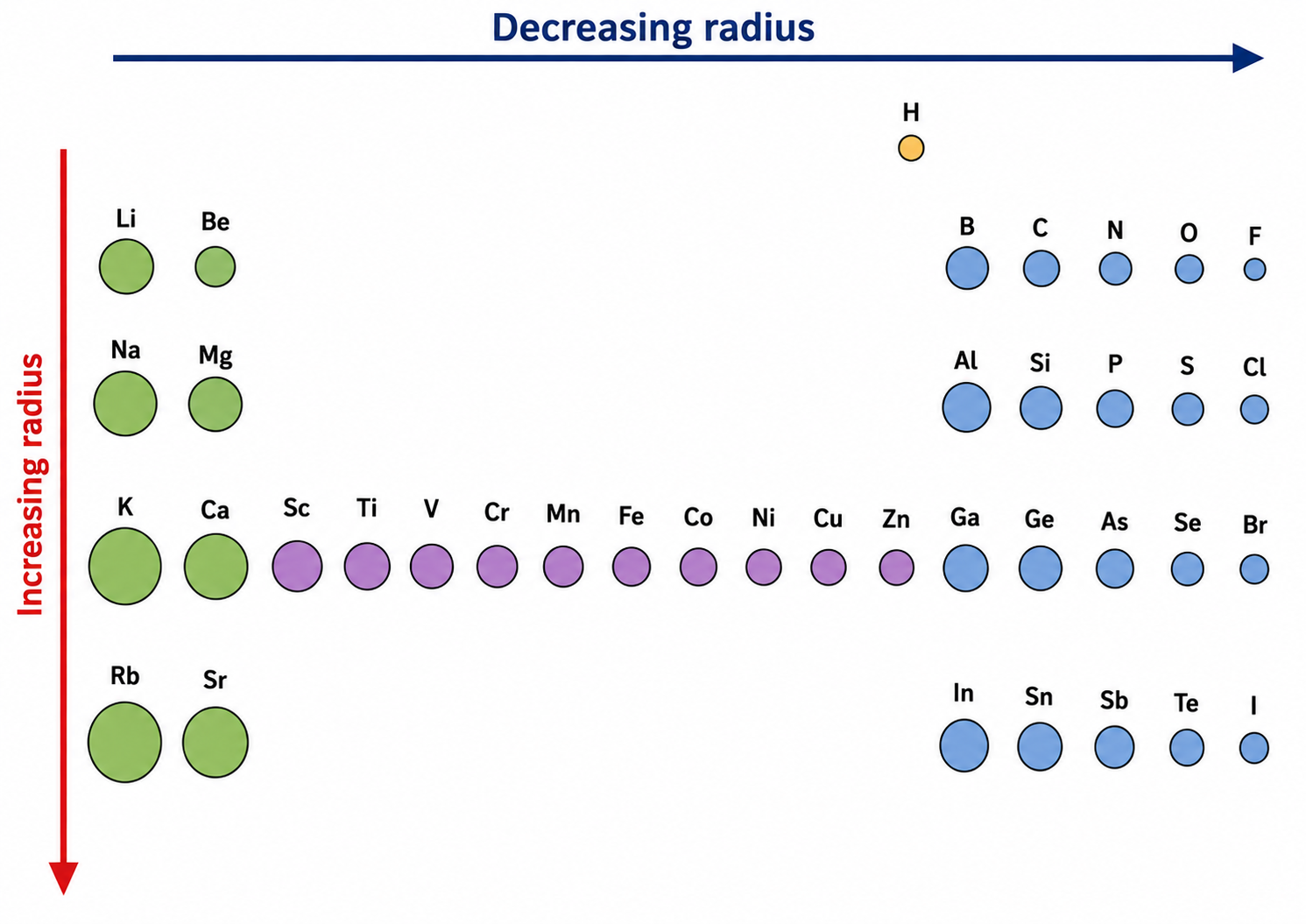
Variations in atomic radius and ionic radius
Atomic radius: the covalent atomic radius is half the distance between the nuclei of two covalently bonded atoms of the same type. This is not the only type of atomic radius, but it provides the best data for comparing elements across a period.
Two major influences on the size of an atom
1
The number of shells: the more shells an atom has, the bigger it should be. We should see this effect as we go down a group.
2
The effective nuclear charge: the larger the charge, the more the orbitals are pulled in towards the nucleus, and so the smaller the atom should be. We should see this effect as we go across a period.
These two factors combine to produce a predictable pattern in the plot of atomic radius against proton number, which is borne out by experimental observations.
- Stable metal ions are smaller than metal atoms because the atoms have lost their outer shell electrons, so the attractive forces between the nucleus and outer electrons are larger.
- Stable non-metal ions are larger than metal atoms because the atoms have gained electrons to complete their outer shells, so the attractive forces between the nucleus and outer electrons is smaller.
Radius trend across the periodic table