3. Atomic Structure
🎯 Learning outcomes
After the completion of the chapter, the students should be able to:
- Describe the Rutherford alpha-ray scattering experiment and the nuclear atomic model
- Explain the limitations of Rutherford’s atomic model.
- Summarise the postulates of Bohr’s atomic theory and its importance.
- List the defects of Bohr’s atomic theory
- Explain the origin of the hydrogen spectra with the help of Bohr’s model.
- Explain the general idea about de Broglie’s wave equation and probability.
- Explain quantum numbers and Planck’s quantum theory.
- Explain the concept and general shapes of s, p, d, and f orbitals.
- Use the Aufbau principle, Pauli Exclusion Principle, and Hund’s rule to write the electronic configuration of the atoms and ions.
Rutherford’s α-rays (α-particles) Scattering Experiment & Nuclear Model of the Atom
The Experiment (1911)
Ernest Rutherford bombarded a very thin gold foil (thickness ~10⁻⁵ cm) with α-particles (helium nuclei, He²⁺) from a radioactive source. Scattered α-particles were detected on a circular ZnS screen that produced tiny flashes of light (scintillations).
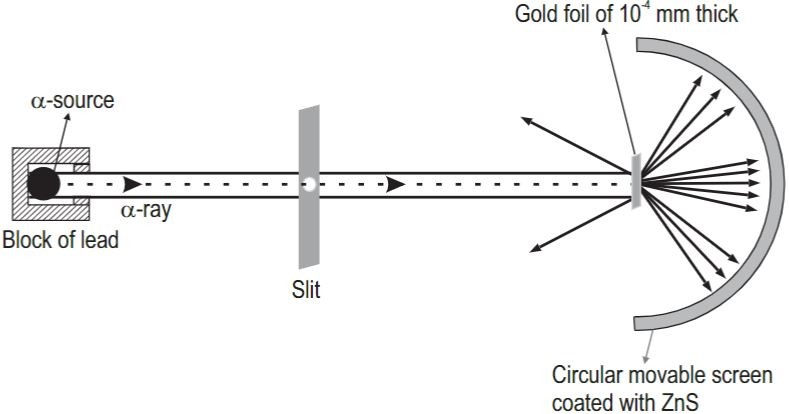
Key Observations
| Observation | What This Tells Us |
|---|---|
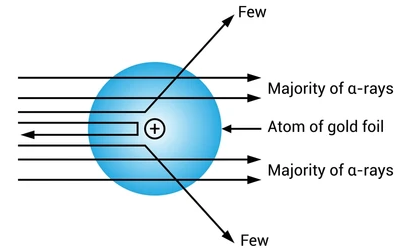
| ≥99% of α-particles passed straight through | An atom is mostly empty space |
| Some deflected at small angles | A small, dense positive region exists inside |
| Very few (~1 in 10,000) bounced back | The nucleus is extremely small but very massive |
Based on the above conclusions, Rutherford put forward the following postulates for his model of the atom, called the Nuclear Model.
- Positive nucleus: A very small, dense, positively charged nucleus sits at the centre and carries almost all the mass.
- Mostly empty: The rest of the atom is largely empty space.
- Neutral atom: The number of electrons outside equals the positive charge of the nucleus.
- Revolving electrons: Electrons revolve around the nucleus, dispersed in the space around it.
- Force balance: Electrostatic attraction between the nucleus and electrons is balanced by the centrifugal force of revolution.
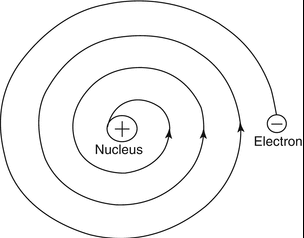
Drawbacks of Rutherford’s Atomic Model
Bohr’s Atomic Model
Niels Bohr (1913), proposed the following postulates based upon Planck’s quantum theory to overcome the shortcomings of Rutherford’s atomic model.
The Main Postulates
- Fixed orbits: Electrons revolve around the nucleus in fixed concentric paths called orbits, shells, or energy levels.
- Stationary orbits: As long as an electron remains in a particular shell, it neither loses nor gains energy. It means the energy of the electrons is constant; hence, these orbits are also called stationary orbits. The energies of electrons increase with increasing distance from the nucleus.
- Quantized angular momentum: Only those orbits are possible where the angular momentum of the electrons is an integral multiple of h/2π. Or the angular momentum of the electrons is quantised.
n = an integer representing the orbits (n = 1, 2, 3, …, ∞)
h = Planck’s constant (6.626 × 10⁻³⁴ Js)
This postulate explains the stability of atoms under ordinary conditions.
- Attraction of nucleus & electrons: The electrostatic force of attraction between the nucleus and an electron is equal to the centrifugal force of the electron. Due to this balance, the electron keeps revolving around the nucleus.
m = mass of an electron | v = velocity of the electron | r = radius of the orbit
- Emission or absorption of energy: The electrons emit or absorb energy in the form of photons (or quanta) only when they jump from one energy level to another. The energy absorbed or radiated equals the difference between the energy of an atom’s lower and higher energy levels.
ν = frequency of radiation (pronounced ‘nu’) | E₂, E₁ = energy of an electron in a higher and lower orbit
The energy is absorbed when an electron jumps from a lower orbit to a higher orbit, and it is radiated when an electron jumps from a higher orbit to a lower orbit. This postulate explains the origin of atomic spectra.
Successes of Bohr’s Atomic Model
- It overcame the defects of Rutherford’s nuclear model of the atom, i.e., it explained the stability of an atom and the origin of atomic spectra in a one-electron system (e.g., H, He⁺, etc.)
- It successfully calculated the radius and energy of an electron in an orbit. By using equations (1) and (2), it was derived,
Explanation of the Stability of an Atom by Bohr’s Atomic Theory
According to Bohr’s postulates, an electron cannot lose energy continuously, unlike explained by classical electrodynamics; instead, it may lose or gain energy only in the form of a packet called a quantum (plural quanta). On the other hand, the electron cannot fall from the first energy level to the nucleus since the angular momentum of an electron is quantised, and the value of mvr cannot be smaller than h/2π. Hence, electrons cannot be nearer to the nucleus than the first orbit.
Explanation of Hydrogen Spectra
When electrical energy is supplied through hydrogen gas filled in a discharge tube at very low pressure, the hydrogen molecules break into atoms. On supplying further energy, the electrons in these atoms, originally in the first shell, absorb energy and move to higher levels, i.e., n = 2, 3, 4, … etc. But an excited electron, being unstable, tends to jump back to lower energy levels and finally to the ground state, i.e., n = 1, after a very short interval of time. While returning to the lower energy level, the electrons emit energy in the form of radiation, which forms the atomic spectra.
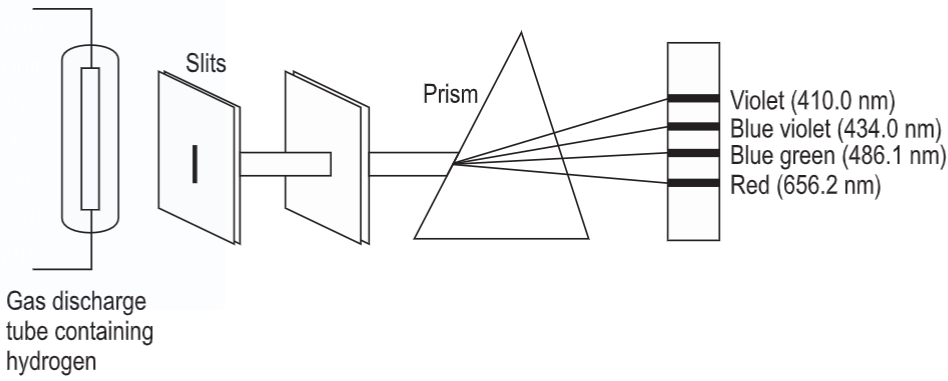
When the electron is in different energy levels, different wavelengths of radiation are produced; this gives spectral lines of different series. The wavelength of the radiation produced when an electron jumps from n₂ (higher orbit) to n₁ (lower orbit) is given by Rydberg’s equation.
n₁ & n₂ = lower and higher energy levels, respectively
Different scientists discovered different spectral series, so they got their names accordingly. Being in the visible range of the electromagnetic spectrum, the Balmer series was discovered first.
1. Lyman series
These spectral lines are obtained when the electron returns from a higher energy level (n₂ = 2, 3, 4 …∞) to a ground state energy level (n₁ = 1). It lies in the ultraviolet region.
2. Balmer series
The spectral lines are obtained when the electron jumps to the second orbit (n₁ = 2) from higher orbits (n₂ = 3, 4, 5, …∞). It is in the visible part.
3. Paschen series
These spectral lines are obtained when the electron jumps to the third shell (n₁ = 3) from higher energy levels (n₂ = 4, 5, 6, …∞). It lies in the infrared region.
4. Brackett series
The various spectral lines of this series are obtained by the jumping of electrons from the fifth, sixth, seventh orbits, etc., to the fourth orbit. It lies in the infrared region (IR).
5. Pfund series
This is obtained when electrons return to n₁ = 5 from n₂ = 6, 7, 8, … etc. It also lies in the IR region.
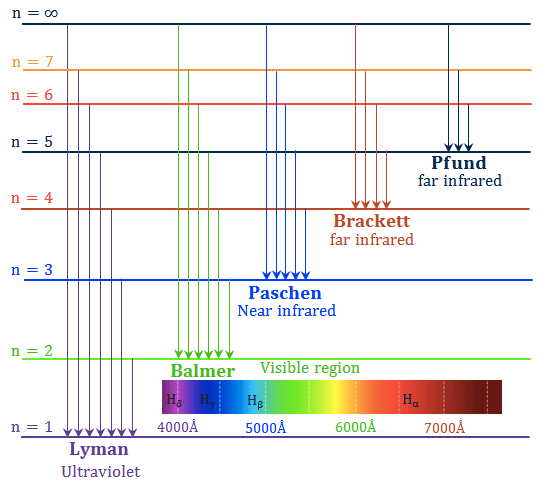
Spectral Series of Hydrogen
| Series | Transition (n₂ → n₁) | Region |
|---|---|---|
| Lyman | n₁ = 1 from (n₂ = 2, 3, 4…) | Ultraviolet (UV) |
| Balmer | n₁ = 2 from (n₂ = 3, 4, 5…) | Visible |
| Paschen | n₁ = 3 from (n₂ = 4, 5, 6…) | Infrared (IR) |
| Brackett | n₁ = 4 from (n₂ = 5, 6, 7…) | Infrared (IR) |
| Pfund | n₁ = 5 from (n₂ = 6, 7, 8…) | Infrared (IR) |
Lower → Higher energy level = Energy absorbed
Neon signs: Different gases produce different colors based on electron transitions (Bohr’s model in action!)
Fireworks: Metal salts emit characteristic colors due to electron jumps
Defects of Bohr’s Theory
- 2D vs 3D: Bohr’s atomic model limits the electron’s motion in a single plane (circular orbit). But atoms being 3-dimensional, the electrons move in 3 dimensions.
- Multi-electron failure: Bohr’s theory could explain the spectral lines of single-electron systems like He⁺, H, Li²⁺, etc., but could not explain the multi-electron systems.
- Fine structure: The hydrogen spectrum under a high-resolution spectroscope shows several closely spaced fine lines inside each line. Bohr’s model could not explain the origin of these fine structures.
- Zeeman & Stark effects: The splitting of spectral lines into still thinner lines in the presence of magnetic & electric fields, called the Zeeman and Stark effects, respectively, couldn’t be explained by Bohr’s theory.
- Ignores wave nature: According to de Broglie, electrons behave as a matter particle as well as a wave. According to Heisenberg’s Uncertainty Principle, accurate measurement of the position & velocity of very small particles like an electron is not possible simultaneously. No such assumptions are in Bohr’s theory.
Zeeman effect: Splitting of spectral lines in a magnetic field.
Stark effect: Splitting of spectral lines in an electric field.
Elementary Idea of Quantum Mechanical Model
The idea of only the particle nature of electrons and the concept of stationary orbits given by Bohr’s theory are completely discarded by the de Broglie equation and Heisenberg’s uncertainty principle. Later on, Schrödinger gave a more advanced model of atoms in the form of a wave equation, which takes into account electrons as particles as well as waves. Under this model, three different concepts are under consideration: 1. de Broglie equation 2. Heisenberg’s uncertainty principle 3. Probability concept.
de Broglie Equation (Dual Nature of Matter)
de Broglie (1924) suggested that, as light has dual character (particle and wave), all material particles in motion have dual character. He derived an equation for that, which was later verified experimentally.
Derivation of de Broglie’s Equation:
From Planck’s quantum theory (wave nature): E = hν = hc/λ …(1)
From Einstein’s mass-energy equation (particle nature): E = mc² …(2)
Combining (1) and (2): hc/λ = mc², solving, λ = h/mc
For an electron with mass m and velocity v:
This equation (3) is the de Broglie equation.
Heisenberg’s Uncertainty Principle
A direct consequence of wave-particle duality: it is impossible to simultaneously measure both the exact position and exact momentum of a microscopic particle.
The meaning of the above equation may be explained as follows:
- If we measure the position accurately, its uncertainty becomes near to 0, then Δp ≥ ∞. It means the uncertainty in momentum becomes infinitely large.
- Similarly, if we measure the momentum accurately, the uncertainty in the position becomes infinite.
Why does this matter? This principle destroys the idea of fixed orbits — we can’t pinpoint where an electron is at any moment. Instead, we talk about the probability of finding an electron.
Probability Concept
Heisenberg’s Uncertainty Principle, de Broglie equation, and wave mechanical model suggest that, as an electron can behave as a particle as well as a wave, its position and velocity cannot be measured accurately at the same time. So, it is evident that only the probability of finding an electron in a particular region of space around the nucleus is possible. This leads to the concept of atomic orbitals.
Orbit vs. Orbital — Key Differences
| Orbit (Bohr’s model) | Orbital (Quantum model) |
|---|---|
| Circular path in a plane (2D) | 3D region of space |
| Exact position of electron is known | Only probability of finding the electron is given |
| Cannot explain molecular shapes | Can explain molecular shapes (directional) |
| Max electrons = 2n² | Max electrons per orbital = 2 |
| Fixed, definite path | No fixed path; defined by probability |
The Shape of s-Orbital
- Shape: spherical and symmetrical in all directions.
- 1s is a single sphere; 2s, 3s are larger concentric spheres with a node (zero probability region) between them.
The Shape of p-Orbitals
p-orbitals have a dumbbell shape with two lobes on the opposite side of the nucleus. There are three mutually perpendicular orbitals. These 3 p-orbitals have equal energies but different orientations; such orbitals are called degenerate orbitals.
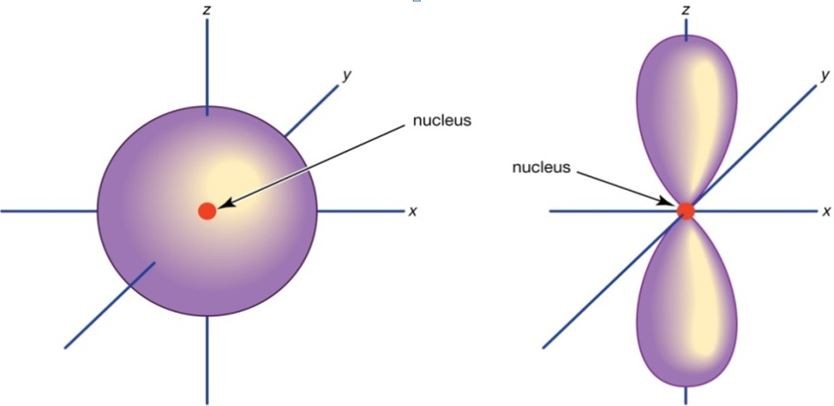
Quantum Numbers
Electrons are distributed in atoms in different shells represented by n = 1, 2, 3, 4, etc. These are called principal quantum numbers. Bohr had introduced them. Sommerfield introduced another quantum number called the azimuthal, or Subsidiary, quantum number. The wave mechanical treatment of atoms reveals that these numbers are not arbitrary. Now, it is clear that 4 sets of quantum numbers are needed to characterise an electron completely.
1. Principal Quantum Number (n)
- Introduced by Bohr’s atomic model to represent the orbits.
- Has positive integer values n = 1, 2, 3, etc., which represent K, L, and M shells, respectively.
- Determines the average distance of the electron from the nucleus and the average energy of an electron.
- Helps to determine the maximum number of electrons that can be accommodated in a shell by the 2n² rule.
| n value | Shell | Max electrons (2n²) | Subshells present |
|---|---|---|---|
| 1 | K | 2 | 1s |
| 2 | L | 8 | 2s, 2p |
| 3 | M | 18 | 3s, 3p, 3d |
| 4 | N | 32 | 4s, 4p, 4d, 4f |
2. Azimuthal Quantum Number (l) / Subsidiary Quantum Number
- Mainly determines the orbital angular momentum of an electron.
- Signifies the subshell to which the electron belongs.
- Helps to find the number of subshells in a given shell.
- Helps to determine the maximum number of electrons that can be accommodated in the given subshell by the 2(2l+1) rule.
- The Azimuthal quantum number may vary from 0 to (n−1) for a given principal quantum number.
| n | l | Subshell |
|---|---|---|
| 1 | 0 | s |
| 2 | 0, 1 | s, p |
| 3 | 0, 1, 2 | s, p, d |
| 4 | 0, 1, 2, 3 | s, p, d, f |
The azimuthal quantum number represents the relative energies of subshells and their shapes. The energies of the subshells are in the following order: s < p < d < f
3. Magnetic Quantum Number (m)
- Describes the behaviour of electrons in a magnetic field.
- Signifies the orientation of the orbital in space in the presence of an external magnetic field.
- Or it specifies the orbital in which an electron lies.
- This successfully explains the Zeeman effect.
- For a given azimuthal quantum number, l, the magnetic quantum number ranges from −l to 0 to +l.
| l value | m values | No. of orbitals | Subshell |
|---|---|---|---|
| 0 | 0 | 1 | s (1 orbital) |
| 1 | −1, 0, +1 | 3 | p (pₓ, pᵧ, p_z) |
| 2 | −2, −1, 0, +1, +2 | 5 | d (5 orbitals) |
| 3 | −3 to +3 | 7 | f (7 orbitals) |
4. Spin Quantum Number (s)
- Determines the spin angular momentum or the direction of the spin of an electron around its axis.
- It can have only two values, +1/2 and −1/2, representing the electrons’ clockwise and anticlockwise rotation.
- Two electrons in an orbital always have opposite spins. These are also represented by ↑ & ↓ or ↿ & ⇂.
| Shell | n | l [0–(n−1)] | m (−l to +l) |
|---|---|---|---|
| K shell | 1 | 0 (s-subshell) | 0 (s-orbital) |
| L shell | 2 | 0 (s), 1 (p) | 0 (s); −1, 0, +1 (p) |
| M shell | 3 | 0 (s), 1 (p), 2 (d) | 0 (s); −1, 0, +1 (p); −2, −1, 0, +1, +2 (d) |
Pauli’s Exclusion Principle
If two electrons in an atom are in different shells, their n values are different.
If two electrons of an atom are in the same shell, they might be in different subshells or have different l values.
If two electrons of an atom are in the same subshell, they can be in different orbitals or have different m values.
If two electrons of an atom are in the same orbital, they have different spin values.
Two electrons in a 2p orbital: both have n=2, l=1, m=+1, but one has s=+½ (↑) and the other s=−½ (↓). Same first three numbers, different spin = allowed!
Hund’s Rule of Maximum Multiplicity
This rule is based on the fact that negatively charged electrons repel each other. If two electrons move in the same region of space, e.g., a 2pₓ orbital, they will repel each other more strongly than if they remain in different regions of space (e.g., 2pₓ and 2pᵧ orbitals). Thus, energetically, it is more favourable for them to go into different orbitals.
| Element | Configuration | Filling pattern (1s, 2s, 2p) |
|---|---|---|
| Boron | 2p¹ | ↑↓ ↑↓ ↑ _ _ |
| Carbon | 2p² | ↑↓ ↑↓ ↑ ↑ _ |
| Nitrogen | 2p³ | ↑↓ ↑↓ ↑ ↑ ↑ (correct) |
| Oxygen | 2p⁴ | ↑↓ ↑↓ ↑↓ ↑ ↑ (correct, not ↑↓↑↓↑↓_) |
Aufbau Principle
Aufbau is a German word meaning building up or construction. This principle states, “The orbitals are filled with electrons in increasing order of their energy.”
The principle may also be explained by the (n+l) rule. According to this rule,
- The orbitals with the lower value of n+l are filled first.
- When two orbitals have the same value of n+l, the orbital with a lower value of n is filled first.
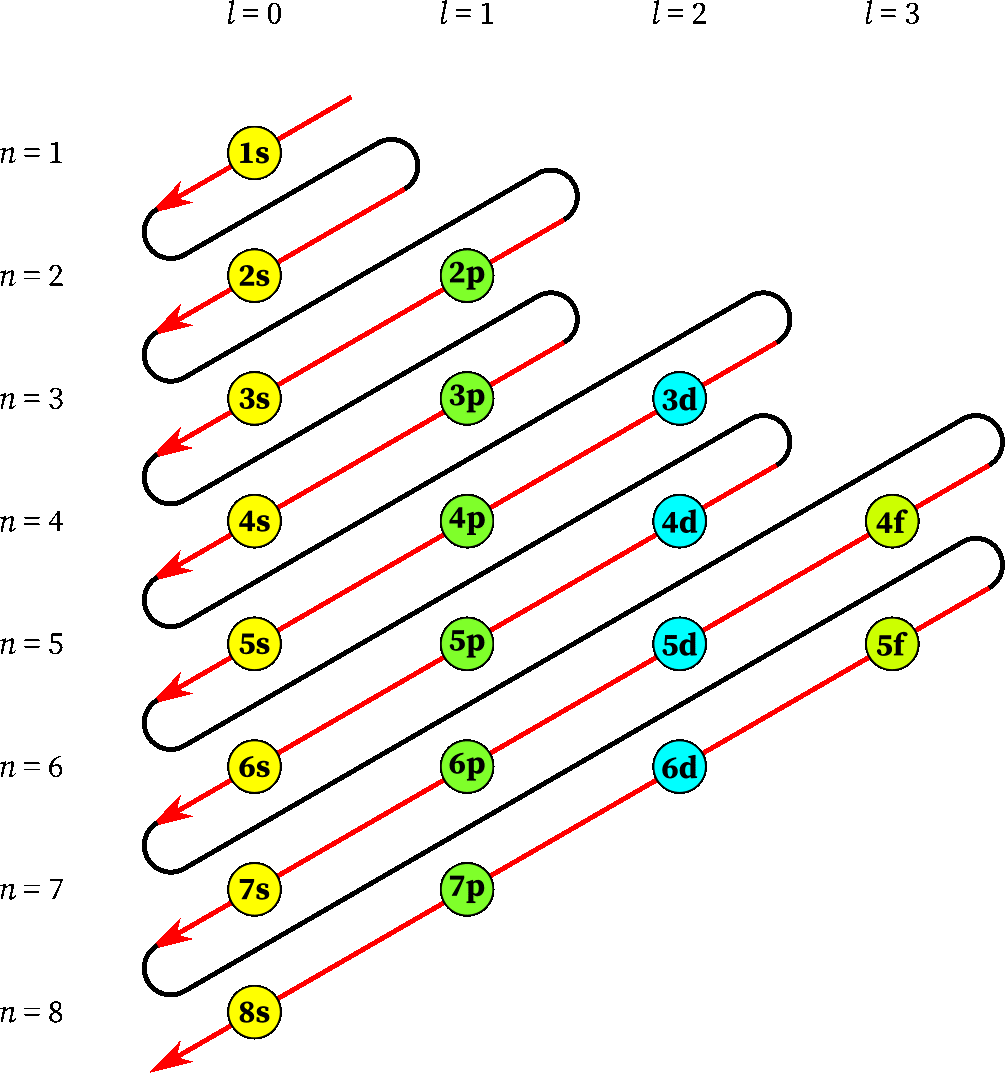
So, the electrons are filled in the following order:
Limitations of the Aufbau Principle (Exceptions)
Cr (chromium, atomic number 24) has an electronic configuration of 1s² 2s²2p⁶ 3s²3p⁶3d⁵4s¹ instead of 1s² 2s²2p⁶ 3s²3p⁶3d⁴4s² because the half-filled d orbital is relatively more stable due to symmetry.
Similarly, Copper (29) has E.C. 1s² 2s²2p⁶ 3s²3p⁶3d¹⁰4s¹ instead of 1s² 2s²2p⁶ 3s²3p⁶3d⁹4s², because a fully filled d-orbital is relatively more stable.
Bohr-Bury Rule
- The maximum number of electrons a shell can hold equals the 2n² rule, where n is the number of shells or principal quantum number.
- The outermost shell cannot have more than 8 electrons, and the next to the outermost shell cannot have more than 18 electrons.
- An orbit doesn’t need to be completely filled before the next orbit starts filling. In fact, a new orbit begins when the outermost orbit gets 8 electrons.