7.2 Liquid State of Matter
🎯 Learning outcomes
By the end of this chapter, students should be able to:
- Explain the physical properties of liquids like evaporation and condensation, vapour pressure and boiling, surface tension, and viscosity in terms of intermolecular force and intermolecular space.
- Describe liquid crystals and their applications.

💧 What makes a liquid different?
- Definite volume ✓
- No definite shape ✗
- Particles are close together
- Particles can move past one another
- Therefore, liquids flow
- It takes the shape of its container.
- The particles have more freedom of movement than in a solid but less than in a gas.
- The properties of a liquid depend mainly on:
- 1. Intermolecular forces — attraction between particles
2. Intermolecular space — small spaces between particles - Stronger intermolecular forces generally make a liquid harder to evaporate and flow.
The conversion of a liquid into vapour from its surface at temperatures below its boiling point.
- Surface phenomena
- A fraction of molecules with kinetic energy high enough escapes the liquid at the surface.
- Endothermic process — causes cooling
Temperature is related to the average kinetic energy of the particles.
During evaporation, higher-energy particles escape from the liquid. The average kinetic energy of the particles left behind decreases, so the liquid cools.
E.g., a drop of ether at room temperature on the hand feels cold
— Sweating occurs during summer to cause cooling by evaporation
Factor affecting evaporation
| Factor | Effect on evaporation |
|---|---|
| Intermolecular force of attraction | Stronger force → lower rate of evaporation |
| Temperature | Higher temperature → higher rate of evaporation |
| Surface area | Larger surface area → higher rate of evaporation |
| Dissolved Non-volatile impurities | More impurities → lower rate of evaporation |
Why does perfume spread through a room?
Why does wet clothing dry faster when spread out?
Why does sweating cool the body?
- Conversion of vapour into liquid generally on cooling
- Condensation of water vapour in the atmosphere leads to rainfall, resulting in the completion of the water cycle.
- The pressure exerted by the vapour of a liquid when the rate of evaporation is equal to the rate of condensation at a given temperature in a closed vessel.
- The vapour pressure of water at a given temperature is also called aqueous tension.
Factors affecting vapour pressure
| Factor | Effect on vapour pressure |
|---|---|
| Nature of liquid | Depends on the strength of intermolecular forces |
| Temperature | Directly proportional — higher temperature, higher vapour pressure |
| Non-volatile impurities | Impurities on the surface reduce evaporation, so vapour pressure decreases |
- Boiling point is a temperature at which the vapour pressure of a liquid equals the atmospheric pressure.
- At normal atmospheric pressure (1 atm), water boils at 100°C.
- Bulk phenomena
- Temperature remains constant during the boiling process. Because the supplied heat is used to overcome intermolecular attractions and convert the liquid into vapour rather than increasing the temperature.
Factors affecting the boiling point
| Factor | Effect on boiling point |
|---|---|
| Intermolecular forces | Stronger force → more energy needed to vaporise the liquid → higher boiling point (e.g., water has a higher boiling point than diethyl ether) |
| Atmospheric pressure | Higher pressure → higher boiling point; lower pressure → lower boiling point (at high altitudes, e.g. in the Himalayas, air pressure is lower, so water boils below 100°C) |
| Dissolved impurities / solutes | Adding a non-volatile solute (like salt) raises the boiling point slightly — this effect is called elevation of boiling point |
Why does water boil at a lower temperature in the mountains?
Boiling and evaporation are somewhat similar processes, but they differ in many respects. The main differences may be outlined as:
| Evaporation | Boiling |
|---|---|
| 1. Occurs at any temperature. | 1. Takes place only at a fixed temperature (the boiling point), where vapour pressure equals atmospheric pressure. |
| 2. A surface phenomenon — occurs only at the liquid’s surface. | 2. A bulk phenomenon — occurs throughout the liquid, at and below the surface. |
| 3. Generally, a slow process. | 3. Generally, a rapid process. |
| 4. No bubbles. | 4. Bubbles formed. |
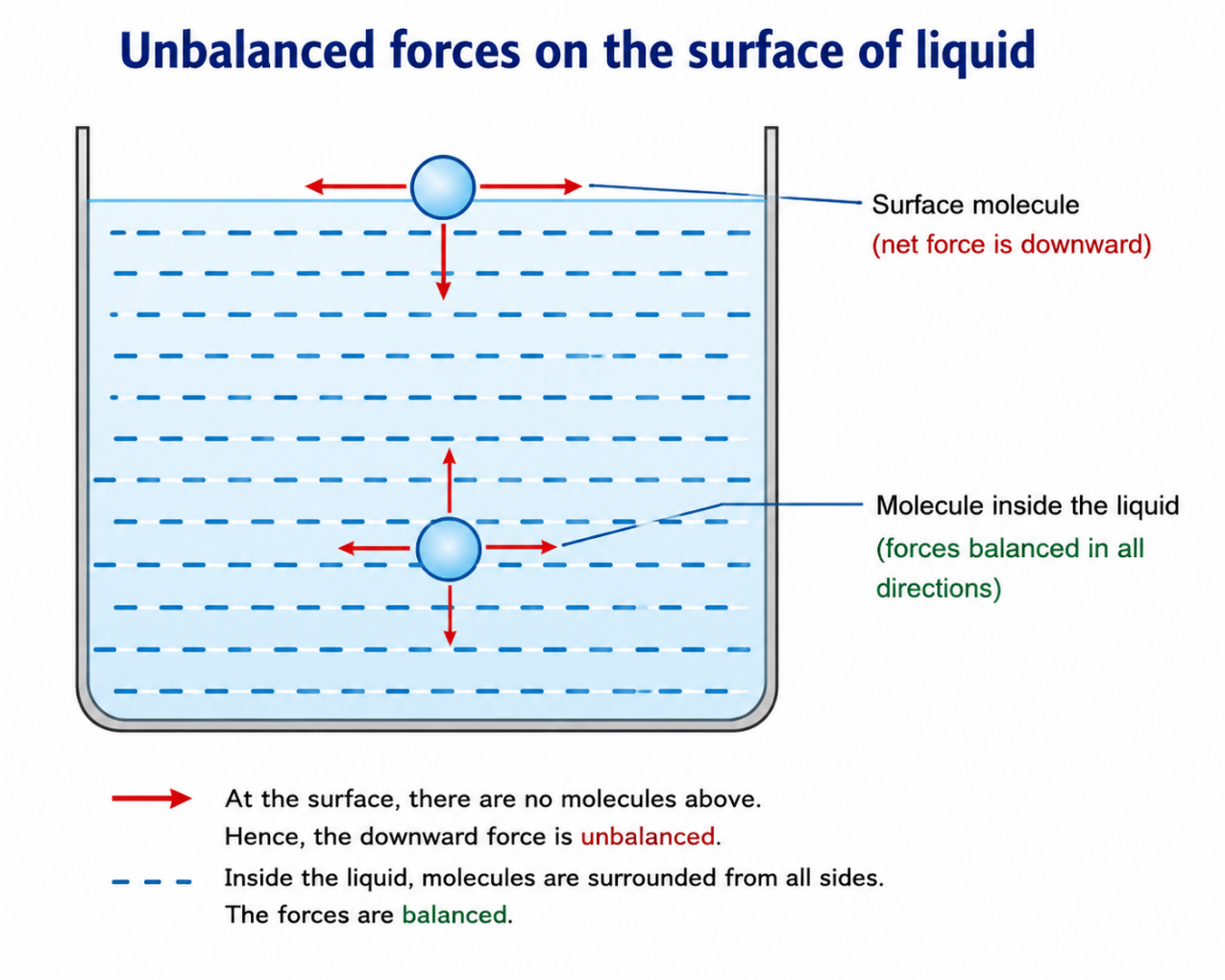
💦 Force acting along the surface of a liquid at a right angle to a line of unit length. Unit: dyne cm⁻¹ (CGS system) or N m⁻¹ (SI system).
Molecules in the bulk are attracted to other molecules from all sides equally, and the resultant force is zero.
But molecules at the surface are pulled towards the bulk due to the net inward pulling force. Due to this, the liquid behaves as a stretched membrane.
Factors affecting surface tension
| Factor | Effect on surface tension |
|---|---|
| Intermolecular force | Stronger force → higher surface tension (water > ethanol > diethyl ether) |
| Temperature | Higher temperature → weaker intermolecular attraction → lower surface tension |
Effects/Applications of surface tension:
- Falling water drops are spherical
- Capillary action (rise of liquid in a narrow tube)
- Soap/detergents act by decreasing the surface tension of water
- 🪲 Some insects can walk on water because of surface tension.
- Hot/warm food is tastier than cold food
- Dirt is removed more easily with hot water than with cold water.
Why are small water drops nearly spherical?
🍯🥛 Which flows faster? Water → cooking oil → honey?
Higher viscosity → slower flow
- Internal resistance offered by a liquid to flow.
- A liquid with high viscosity flows slowly, while a liquid with low viscosity flows easily.
- Internal resistance or friction produced by one layer of liquid flowing over an adjacent layer with different velocities.
- Consider a liquid flowing through a narrow pipe. The liquid is supposed to flow in different layers.
- Different layers of liquid flow at different speeds.
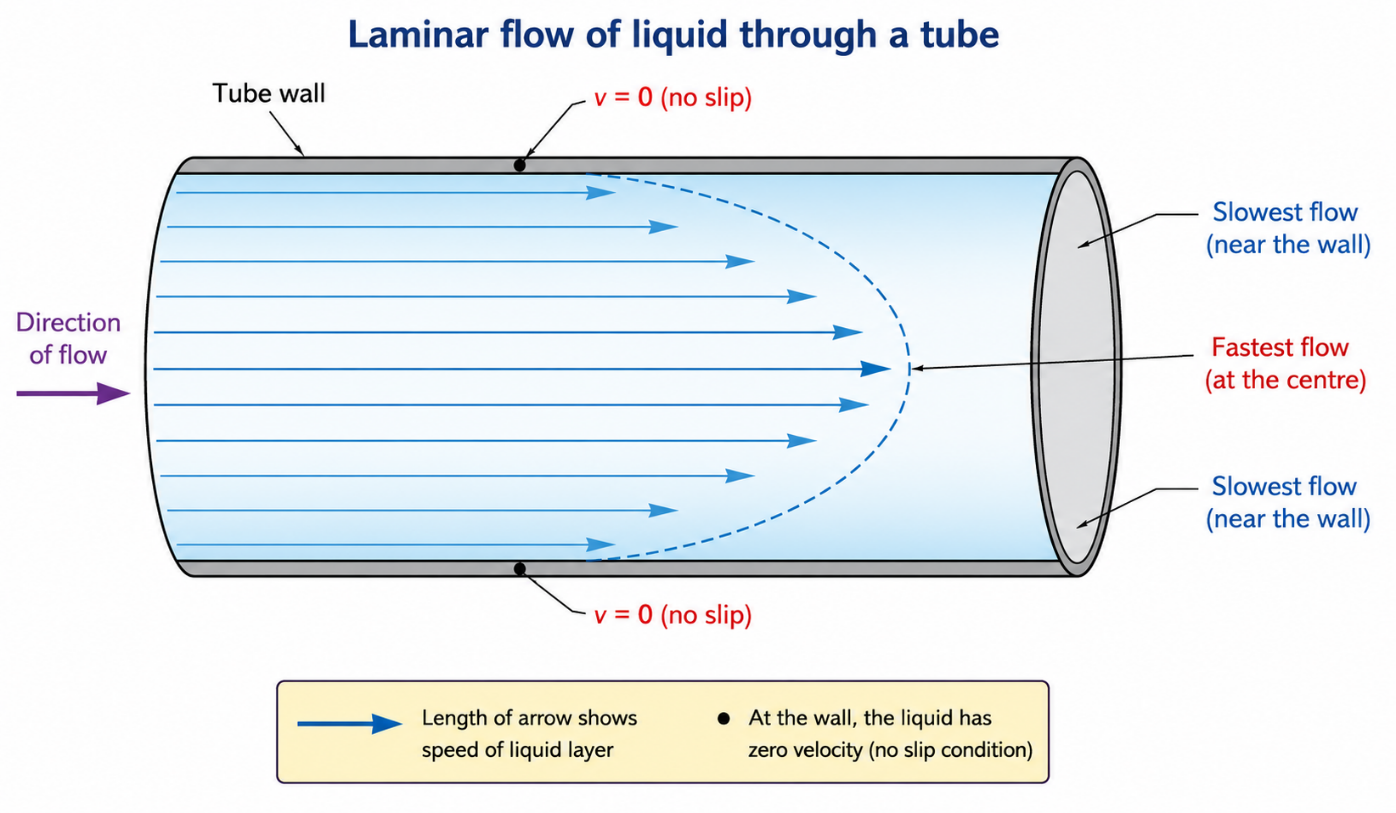
- It has been found that the frictional force between two adjacent layers is directly proportional to the area of contact and the velocity gradient.
Frictional force (F) ∝ velocity gradient (dv/dx) ……… (II)
Combining equations (I) and (II),
F ∝ A · dv/dx
Or, F = η A dv/dx
Where η is the proportionality constant, called the coefficient of viscosity.
If A = 1 cm², dv = 1 cm/s, dx = 1 cm, then F = η.
- Coefficient of viscosity: the force per unit area required to maintain a unit velocity gradient.
- The greater the coefficient of viscosity, the greater the viscous force.
- Unit of coefficient of viscosity: CGS — dynes s cm⁻² or poise; SI — Newton s m⁻² or Poiseuilli
Factors affecting viscosity
| Factor | Effect on viscosity |
|---|---|
| Intermolecular force | Stronger force → higher viscosity (e.g., water < mustard oil < honey < glycerine) |
| Temperature | Higher temperature ↑ – lower viscosity ↓ Reason: on heating, molecules gain kinetic energy and can overcome intermolecular forces more easily |
Why does honey flow more slowly than water?
Stronger intermolecular force → Effect
| Stronger intermolecular force | Effect |
|---|---|
| ↑ attraction | ↓ evaporation |
| ↑ attraction | ↓ vapour pressure |
| ↑ attraction | ↑ boiling point |
| ↑ attraction | ↑ surface tension |
| ↑ attraction | ↑ viscosity |
Ordinary liquids are isotropic — their properties (like refractive index) are the same in every direction, because their particles are arranged randomly. Crystalline solids are the opposite: they are anisotropic, meaning their properties change with direction, because their particles are arranged in a fixed, orderly pattern.
Some special substances behave in between these two extremes. They can flow and take the shape of their container, just like a liquid — but their particles (usually long, rod-shaped molecules) still line up in a regular, crystal-like arrangement, instead of moving around completely randomly. Such substances are called liquid crystals. They combine one property of liquids (flow) with one property of solids (molecular order).
Liquid crystals are special materials that have properties between those of ordinary liquids and crystalline solids.
They can flow like liquids, but their molecules have some order like a crystal.
Think of a box of matchsticks. If you pour them out loose, they point in random directions — that’s like a normal liquid. If you pack them tightly in neat rows in the box, they’re all lined up — that’s like a solid crystal. A liquid crystal is like matchsticks floating in water but still all pointing roughly the same direction — free to move around, yet still lined up.
Applications of liquid crystals
- Liquid crystal display (LCD) screens — the main use — found in televisions, computer monitors, laptops, and mobile phones.
- Digital watches and calculator screens, which show numbers using the same on/off light principle.
- Liquid crystal thermometers — some liquid crystals change colour with temperature, so they are used in strip thermometers and mood rings.
- Optical switching devices and certain sensors in scientific and medical equipment.
Ans: Liquid crystals can change the way light passes through them when an electric field is applied.
Key Points to Remember
- Liquids are intermediate between solids and gases — particles move continuously but slower than in a gas.
- Evaporation is a surface phenomenon at any temperature; boiling is a bulk phenomenon at a fixed temperature where vapour pressure = atmospheric pressure.
- Evaporation is endothermic, so it causes cooling.
- Vapour pressure rises with temperature and falls with non-volatile impurities.
- Surface tension (N m⁻¹) arises from the net inward pull on surface molecules; it falls as temperature rises.
- Viscosity (poise / poiseuille) is internal friction between liquid layers; it also falls as temperature rises.
- Liquid crystals flow like liquids but have a crystal-like particle arrangement — used in LCD screens.