1. Language of Chemistry
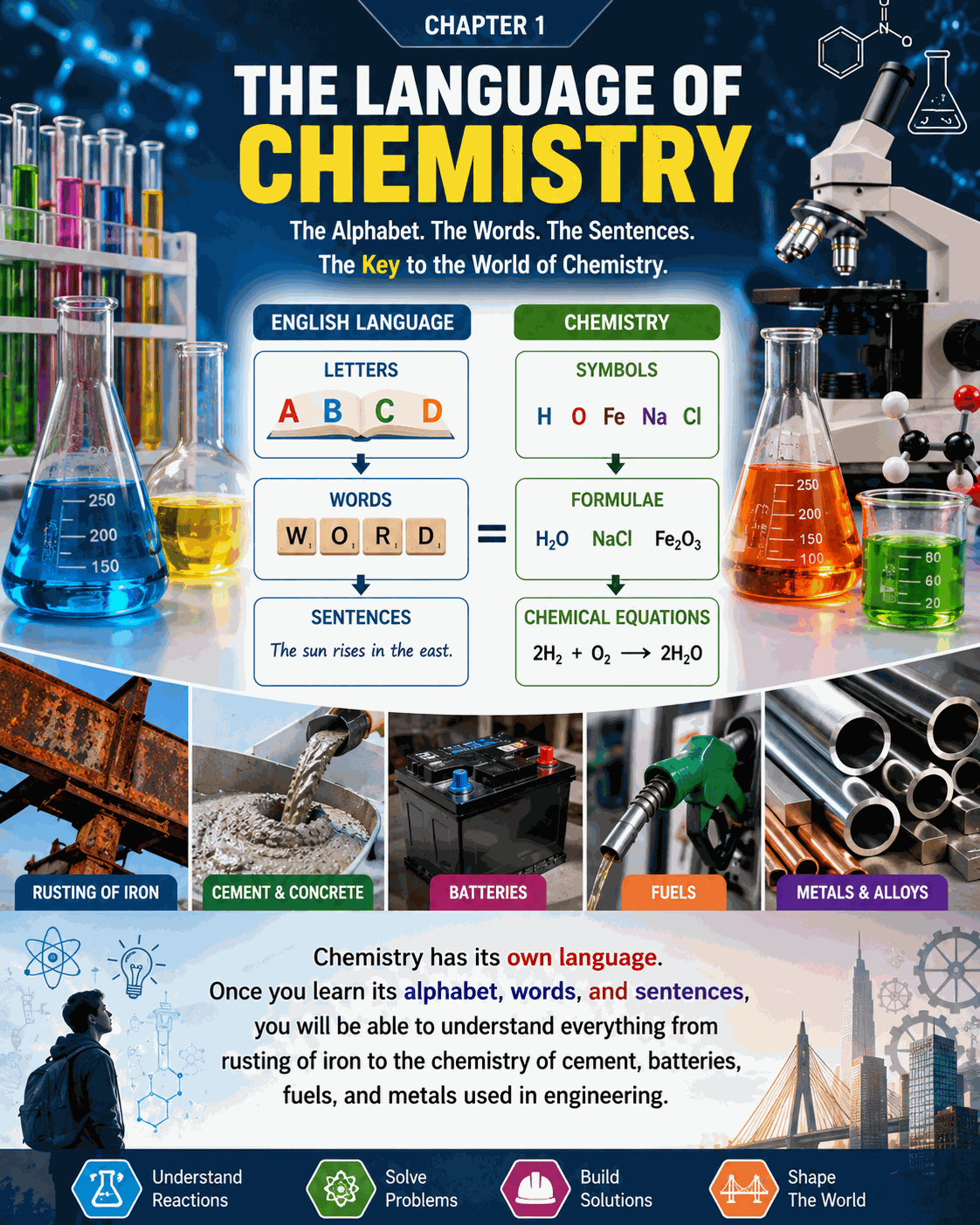
The Language of Chemistry
Just like learning English requires the alphabet, then words, then sentences — learning chemistry means mastering the “Alphabet” (Symbols), the “Words” (Formulas), and the “Sentences” (Chemical Equations). Let’s make it simple, logical, and fun!
Syllabus at a glance
1.1 Symbol
- Introduction & definition
- Names and symbols up to atomic no. 30
- Symbols derived from Latin / other languages
- Qualitative & quantitative significance
1.2 Formula, valency & radicals
- Molecular & structural formula
- Valency (combining capacity with H₂, O₂, Cl₂)
- Variable valency & radicals
- Methods of writing formulas
1.3 Chemical equation
- Essentials, significance & limitations
- Balancing: hit & trial, partial equation
- Types of reactions
- Conditions for reactions
Symbols
In chemistry, we don’t always want to write the full names of elements like “Hydrogen” or “Oxygen” every time. Instead, we use short forms — symbols.
Elements 1 to 30
To succeed in chemistry, you need to know the first 30 elements of the periodic table by heart. Fill in the blank valency cells as practice.
| At. No. | Element | Symbol | Valency | At. No. | Element | Symbol | Valency |
|---|---|---|---|---|---|---|---|
| 1 | Hydrogen | H | 16 | Sulphur | S | ||
| 2 | Helium | He | 17 | Chlorine | Cl | ||
| 3 | Lithium | Li | 18 | Argon | Ar | ||
| 4 | Beryllium | Be | 19 | Potassium | K | ||
| 5 | Boron | B | 20 | Calcium | Ca | ||
| 6 | Carbon | C | 21 | Scandium | Sc | 3 | |
| 7 | Nitrogen | N | 22 | Titanium | Ti | Variable | |
| 8 | Oxygen | O | 23 | Vanadium | V | Variable | |
| 9 | Fluorine | F | 24 | Chromium | Cr | Variable | |
| 10 | Neon | Ne | 25 | Manganese | Mn | Variable | |
| 11 | Sodium | Na | 26 | Iron | Fe | 2, 3 | |
| 12 | Magnesium | Mg | 27 | Cobalt | Co | Variable | |
| 13 | Aluminium | Al | 28 | Nickel | Ni | 2 | |
| 14 | Silicon | Si | 29 | Copper | Cu | 1, 2 | |
| 15 | Phosphorus | P | 30 | Zinc | Zn | 2 |
Symbols derived from Latin and other languages
You might notice that Sodium is “Na” and Iron is “Fe”. Why not “So” and “Ir”? Many elements were discovered a long time ago, and their symbols come from their historical Latin names.
| Element | Latin name | Symbol | Element | Latin name | Symbol |
|---|---|---|---|---|---|
| Sodium | Natrium | Na | Copper | Cuprum | Cu |
| Potassium | Kalium | K | Gold | Aurum | Au |
| Iron | Ferrum | Fe | Lead | Plumbum | Pb |
| Mercury | Hydrargyrum | Hg | Silver | Argentum | Ag |
| Tin | Stannum | Sn | |||
Significance of a symbol
Qualitative significance
- Tells us which element it is — ‘C’ always stands for carbon, nothing else.
- Makes it easy to remember the name and write a chemical equation.
Quantitative significance
- Represents a single atom of the element (e.g., C = one atom of Carbon, atomic mass 12).
- Represents the stoichiometric quantity — i.e. 1 mole of C, or 12 g of C.
- Represents a fixed mass of the element in a chemical reaction.
Practice — Symbols
- Write the symbols for the following elements: Potassium, Iron, Mercury, Silver, and Lead. (1 each)
- What do you mean by symbol? Write its qualitative and quantitative significance. (3)
- Write the significance of the symbols a) Cu b) F (2)
- Explain the symbol and its significance. (2)
Test yourself on Symbols
Take this short quiz before moving on to Radicals.

Radicals — the team players
Classification by charge
Electro-positive radicals
Carry a positive charge, e.g. Na+, NH4+, Ca2+, Al3+
Electro-negative radicals
Carry a negative charge, e.g. Cl−, SO42−, NO3−
Classification by size
Classification by source
Acid radical
Negatively charged radicals coming from an acid, e.g. Cl−, SO42−, NO3−
Basic radical
Positively charged radicals coming from a base, e.g. NH4+, K+, Mg2+
| Radical | Name | Valency | Radical | Name | Valency |
|---|---|---|---|---|---|
| Cl⁻ | Chloride ion | Na⁺ | Sodium ion | ||
| NO₃⁻ | Nitrate ion | K⁺ | Potassium ion | ||
| SO₄²⁻ | Sulphate ion | Ca²⁺ | Calcium ion | ||
| CO₃²⁻ | Carbonate ion | Al³⁺ | Aluminium ion | ||
| HCO₃⁻ | Bicarbonate ion | NH₄⁺ | Ammonium ion |
Fill in the valency of each ion above. Valency of a radical = the number of charges, ignoring the sign (positive or negative).
Practice — Radicals
- Write the differences between acid radicals and basic radicals.
- Define radicals and explain their types with examples.
- Write short notes on radicals.
- What is the difference between a simple radical and a compound radical? Give one example of each.
Test yourself on Radicals
Take this short quiz before moving on to Valency.
Valency — the combining capacity
You can think of valency as the number of “hands” an atom has to hold onto other atoms.
For example, in H2O, one Oxygen atom combines with two Hydrogen atoms, so the valency of Oxygen is 2.
| Compound | Valency of the metal |
|---|---|
| AgCl | 1 |
| NaCl | 1 |
| MgCl₂ | 2 |
| AlCl₃ | 3 |
| AuCl₃ | 3 |
| CrCl₃ | 3 |
| SnCl₄ | 4 |
Variable valency
Elements that show variable valency include Iron (Fe), Tin (Sn), Copper (Cu), Lead (Pb), Mercury (Hg), Sulphur (S), and Nitrogen (N).
| Molecular formula | Name of the compound | Valency of metal |
|---|---|---|
| FeCl₂ | Ferrous chloride | 2 |
| FeCl₃ | Ferric chloride | 3 |
| CuCl | Cuprous chloride | 1 |
| CuCl₂ | Cupric chloride | 2 |
| SnCl₂ | Stannous chloride | 2 |
| SnCl₄ | Stannic chloride | 4 |
| PbCl₂ | Plumbous chloride | 2 |
| PbCl₄ | Plumbic chloride | 4 |
Some non-metals also show variable valency:
Practice — Valency
- What is variable valency? Give two examples. (1+2)
- What do you mean by valency and variable valency?
- Define variable valency and list three elements that exhibit it.
Test yourself on Valency
Take this short quiz before moving on to Formula.
Formula
When atoms combine, they form molecules. To represent molecules, we write formulas.
Molecular formula
Shows the exact number and type of atoms present in one molecule of a substance. Example: H₂O tells us water has 2 Hydrogen atoms and 1 Oxygen atom.
Structural formula
A diagram showing exactly how atoms are connected or bonded in space. Example: H–O–H.
Methods of writing molecular formulas — the Criss-Cross method
- Write the symbols of the radicals side-by-side (positive on the left, negative on the right).
- Write their valencies below them.
- “Criss-cross” the valencies to the bottom right of the opposite symbol. (Drop the + or − signs.)
- Simplify the numbers if they can be divided by a common factor.
Writing the formula for Aluminium Oxide:
- Symbols: Al and O
- Valencies: 3, 2
- Criss-cross result: Al₂O₃
Practice — Formula
- Use the criss-cross method to write the chemical formula for:
- Calcium Chloride (Ca valency = 2, Cl valency = 1)
- Magnesium Sulphate (Mg valency = 2, SO₄ valency = 2)
- Write the chemical formula for the following compounds (1 each):
- Sodium chloride, Potassium fluoride, calcium oxide, magnesium fluoride
- Sodium sulphide, calcium sulphide, Lithium iodide, aluminium chloride
- Calcium hydroxide, aluminium oxide, aluminium sulphate, calcium nitrate
- Lithium nitrate, magnesium nitrate, sodium hydroxide, potassium hydroxide
- Ammonium carbonate, Ammonium hydroxide, sodium nitrate, calcium hydroxide
- Calcium carbonate, magnesium carbonate, sodium carbonate, potassium carbonate
- Calcium sulphate, Potassium sulphate, Ammonium sulphate, potassium chloride
- Sodium nitrate, Magnesium nitrate, Ammonium nitrate, Sodium sulphite
- Calcium bisulfite, Magnesium bisulfate, cuprous carbonate, zinc chloride
- Mercuric nitrate, ferrous chloride, ferric chloride, Cupric carbonate
- Ferrous sulphate, Ferric sulphate, Mercurous carbonate, cupric sulphate
- Differentiate between a molecular formula and a structural formula.
Significance of a molecular formula
Qualitative
Tells us the name of the compound and which elements are in it.
Quantitative
- Exactly one molecule of the compound and the ratio of atoms
- 1 mole of substance = 6.023 × 10²³ molecules
- Molecular mass of the substance
- Number of each kind of atom
The molecular formula of copper sulphate crystal is CuSO₄·5H₂O. It contains one copper atom, one sulphur atom, four oxygen atoms and five water molecules.
More practice
- Define formula and explain its significance with suitable examples.
- What is a molecular formula? Write molecular formulas of compounds: (i) Sodium carbonate (ii) Magnesium oxide (iii) Ammonium thiocyanate (iv) Sodium nitrate. What information do you obtain from the formula NaCl? (1+2+2)
Chemical equations
When a chemical reaction happens, we write it down as a chemical equation — it’s like a sentence that tells a short story about a chemical change.
Essentials of a chemical equation
For an equation to be valid, it must:
- Represent an actual, true chemical change.
- Be balanced — the number of atoms for each element must be equal on both sides.
- Be written in molecular form (e.g., write O₂ for oxygen gas, not just O).
Significance: tells us the reactants and products (qualitative) and how many moles/molecules are reacting (quantitative).
A. NaOH + H₂SO₄ → Na₂SO₄ + H₂O
Qualitative significance
- Sodium hydroxide and sulphuric acid are reactants. Sodium sulphate and water are the products.
- Sodium hydroxide reacts with sulphuric acid to give sodium sulphate and water.
Quantitative significance
- 2 moles of NaOH reacts with 1 mole of H₂SO₄ to produce 1 mole of Na₂SO₄ and 2 moles of H₂O
- 80 g of NaOH reacts with 98 g of H₂SO₄ to give 142 g of Na₂SO₄ and 36 g of H₂O
B. CaCO₃ + 2HCl → CaCl₂ + H₂O + CO₂
Qualitative significance
- Calcium carbonate and hydrochloric acid are reactants. Calcium chloride, water and carbon dioxide gas are products.
- Calcium carbonate reacts with hydrochloric acid to give calcium chloride, water and carbon dioxide gas.
Quantitative significance
- 1 mole of CaCO₃ reacts with 2 moles of HCl to produce 1 mole of CaCl₂, 1 mole of H₂O and 1 mole of CO₂
- 100 g of CaCO₃ reacts with 73 g of HCl to give 111 g CaCl₂, 18 g water and 44 g CO₂
C. Na₂CO₃ + 2HCl → 2NaCl + H₂O + CO₂
Qualitative significance
- Sodium carbonate reacts with hydrochloric acid to produce sodium chloride, water and carbon dioxide.
Quantitative significance
- One molecule of sodium carbonate reacts with two molecules of hydrochloric acid to produce two molecules of sodium chloride, one molecule of water and one molecule of carbon dioxide gas.
- 106 parts by weight of sodium carbonate reacts with 73 parts by weight of hydrochloric acid to produce 117 parts by weight of sodium chloride, 18 parts by weight of water and 44 parts by weight of carbon dioxide gas.
- One mole of sodium carbonate reacts with hydrochloric acid to produce 1 mole of carbon dioxide gas (22.4 litres at N.T.P.)
Practice
- Write the qualitative and quantitative significance of chemical equations (see A/B/C above). (3/4/5)
- Define a chemical equation and write its significance.
Limitations
A standard chemical equation does not tell us:
Practice
- What are the essentials and limitations of chemical equations? (4)
Making the equation more informative
To fix these limitations, we add extra symbols:
Practice
- Why are chemical equations limited, and how can we make them more informative?
Balancing chemical equations
By law, matter cannot be created or destroyed. We must balance equations to ensure the same number of atoms exists on both sides.
1. Hit and trial method
Used for simple reactions. You guess and check by adding numbers in front of formulas until both sides match.
H₂ + O₂ → H₂O (unbalanced — 2 O on left, 1 O on right)
2H₂ + O₂ → 2H₂O (balanced — 4 H and 2 O on both sides)
Step by step: N₂ + H₂ → NH₃
- Count atoms. Left: 2 N, 2 H. Right: 1 N, 3 H. Not balanced.
- Balance Nitrogen first. Put 2 in front of NH₃: N₂ + H₂ → 2NH₃. Now Nitrogen is balanced (2 = 2).
- Balance Hydrogen. The right side now has 6 H (2×3). Put 3 in front of H₂: N₂ + 3H₂ → 2NH₃.
- Check again. Left: 2 N, 6 H. Right: 2 N, 6 H. Balanced!
Practice
- Balance the following equations using the hit-and-trial method:
- KClO₃ → KCl + O₂
- CH₄ + O₂ → CO₂ + H₂O
2. Partial equation method
Used for complex reactions too hard to balance by simply guessing (e.g., reactions involving strong oxidising agents like HNO₃, MnO₂, KMnO₄, K₂Cr₂O₄, etc.).
- Break the complex reaction into two or more simpler “partial” equations.
- Balance these simple equations individually.
- Multiply the equations by suitable integers so intermediate products cancel out.
- Add them together for the final balanced equation.
Types of chemical reactions
Practice
- State the type of chemical reaction for the following:
- CaCO₃ → CaO + CO₂
- HCl + NaOH → NaCl + H₂O
- What is a neutralisation reaction?
Conditions of bringing about chemical reactions
Chemicals don’t always react just by sitting next to each other. They often need a “push”:
| Condition | Example equation |
|---|---|
| By simple contact | 2P + 3I₂ → 2PI₃ |
| By contact through solution | AgNO₃(aq) + NaCl(aq) → AgCl(s) + NaNO₃(aq) |
| By application of heat | Cu + 2H₂SO₄ → CuSO₄ + 2H₂O + SO₂ |
| By pressure and light | CH₄ + Cl₂ → CH₃Cl + HCl |
| By application of electricity | 2H₂O → 2H₂↑ + O₂↑ |
Final review quiz
Wrap up the chapter with this comprehensive quiz.
Glossary — important English words in this chapter
Chemistry uses some English words that may be new to you. Here are their simple meanings.