10.1 Metals and Metallurgy
Look around you.
Your mobile phone, bicycle, electrical wires, buildings, cooking utensils and vehicles all depend on metals.
But metals are rarely found in nature as pure metals. They are usually present in minerals. How do we turn a rock containing a metal compound into a useful, pure metal?
🎯 Learning outcomes
Learners should be able to:
- Define metallurgy and its types (hydrometallurgy, pyrometallurgy, and electrometallurgy).
- Define ores, gangue or matrix, flux and slag, alloy and amalgam.
- Explain general principles of extraction of metals (different processes involved in metallurgy) – concentration, calcination and roasting, smelting, carbon reduction, thermite and electrochemical reduction.
- Describe refining of metals (poling and electro-refining).
- Most of the elements in the periodic table are metals; the rest are non-metals and metalloids.
- Elements lying on the borderline have intermediate properties between metals and non-metals called metalloids.
- Metals are usually solid, hard, good conductors of heat and electricity and possess metallic lustre; they are malleable and ductile.
- On the other hand, non-metals are solids, gases or liquids (bromine) and poor conductors of electricity. Besides, they generally lack lustre and are brittle when solid.
- Metalloids are borderline elements of the p-block, which show both metallic and non-metallic characters. E.g., B, Si, Ge, As, Te, etc. These possess metallic lustre but form acidic oxides.
Distinction between metals and non-metals
| Metals | Non-Metals |
|---|---|
| 1. Usually Solids | 1. All 3 states |
| 2. Metallic lustre | 2. Non-lustrous |
| 3. Usually High density | 3. Low density |
| 4. Good conductors | 4. Poor conductors |
| 5. Malleable and ductile | 5. Brittle |
| 6. Usually High Melting point and Boiling point. | 6. Low |
| 7. Usually Basic oxides | 7. Acidic oxides |
| 8. Electropositive (low IP) | 8. Electronegative (high IP) |
Why is copper used in electrical wires?
Metals are essential materials in modern life. Iron is used in buildings and machines, copper in electrical wires, aluminium in aircraft and utensils, and gold and silver in jewellery and electronics. But how are these metals obtained from rocks? This is the subject of metallurgy.
- Metals, being reactive, cannot exist in free form (except a few like Gold, Copper, etc.).
- They generally exist in nature in the form of their compounds.
- Minerals can be defined as compounds existing in nature in large amounts that contain metals.
- Ores are the minerals from which metals can be extracted conveniently and economically.
- Thus, every ore is a mineral, but not every mineral is an ore. e.g., clay (Al₂O₃.2SiO₂.2H₂O) is a mineral of aluminium but is not an ore. Bauxite (Al₂O₃.2H₂O) is both a mineral and an ore of aluminium.
Which metals can be obtained from the following ores? Galena, Cinnabar, Argentite.
Solution: Galena is PbS (lead sulphide). Lead (Pb) can be obtained from it. Cinnabar is HgS (mercuric sulphide). Mercury (Hg) can be obtained from it. Argentite is Ag₂S (Silver sulphide). Silver (Ag) can be obtained from it.
Alloys and amalgams
An alloy is a mixture of two or more elements in which at least one component is a metal. e.g. Brass (Cu + Zn), Bronze (Cu + Sn), etc.
An amalgam is an alloy containing mercury. For example: sodium amalgam, zinc amalgam.
Important mineral deposits in Nepal
The Department of Mines and Geology has identified more than 1,000 mineral deposits/occurrences across the country.
| Metal | Ore | Place of occurrence |
|---|---|---|
| Iron | Magnetite / Haematite | Phulchowki, Lalitpur, Ramechhap, Tanahu etc. |
| Copper | Copper ore deposit | Solukhumbu, Makawanpur, Dhading, Udayapur |
| Lead/Zinc | Lead-zinc deposit | Ganesh Himal, Rasuwa |
| Cobalt | Cobalt ore | Suwarbhuwar, Gulmi |
| Bismuth | Bismuth ore | Bhimphedi, Makawanpur |
| Gold | Native (traces) | Swayambhu-Halchowk area |
| Magnesium | Magnesite Talc | Kharidhunga, Dolkha, Udayapur Kharidhunga, Dolkha, Udayapur |
| Calcium | Limestone | Chobhar, Kathmandu, Udayapur; Jogimara, Dhading, Okhare, Makawanpur |
Pyrometallurgy 🔥 (pyro means heat 🔥)
- Pyrometallurgy is the process of obtaining metal from its ore at high temperatures.
- This process is employed for the extraction and purification of less electropositive metals like Cu, Fe, Zn, Hg, etc.
- In this process, after the removal of the main impurities from the ore it is converted into a suitable form (generally oxides) and heated strongly with a suitable reducing agent to get molten metal.
Hydrometallurgy
- In this type of metallurgy, a suitable reducing agent is added to the aqueous solution of the metal to precipitate the metal.
- Hydrometallurgy is suitable if the percentage of metal in the ore is very low. For example, the extraction of gold and silver.
Electrometallurgy
- This method is usually employed for the extraction of electropositive metals like Na, K, Ca, Mg, etc.
- In electrometallurgy, a molten or aqueous compound of the metal is electrolysed to obtain the metal by reduction at the cathode.
- The pure metal is obtained at the cathode, leaving behind impurities in the anode.
Highly electropositive metals such as Na, K, Ca and Mg cannot be readily extracted by carbon reduction because their compounds are very stable and these metals have a greater affinity for oxygen than carbon. Therefore, they are generally extracted by electrolytic reduction of their molten salts.
- Extraction of metals from ores involves several steps.
- The branch of science that deals with the extraction of metals from natural sources is called Metallurgy.
- In a combined state, metals do not exist as pure compounds; they are mixed with sand, clay, limestone, etc.
- These unwanted earthy impurities present in the minerals are called gangue or matrix.
- First, these impurities should be removed to get metals from minerals.
Gangue or matrix is waste matter that is to be completely removed to get metal from its ore. For example, for the extraction of copper from copper pyrites, the gangue or impurities are iron oxide, calcium carbonate, sand, etc.
1. Crushing and pulverisation ⛏️
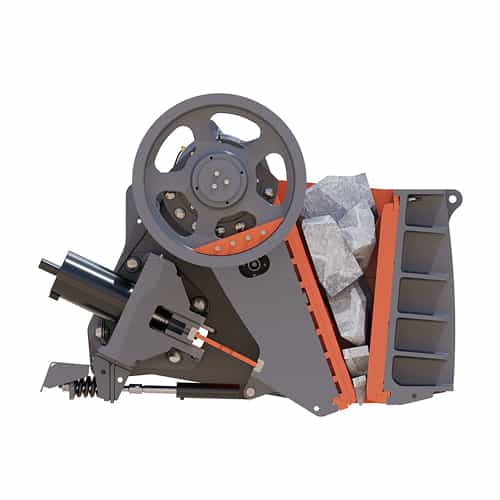
Usually, ores are taken out from the mines in huge pieces. These big pieces of ore are crushed into smaller pieces using jaw crushers and then pulverised or powdered into fine powder using pulverisers (stamp mills).
2. Concentration (dressing) 🔍
Ores usually contain unwanted earthy substances like soil, sand, stones and silicates as gangue or impurities. Removal of such impurities from ore is called concentration or dressing of the ore. The method used for the concentration of ore depends upon the nature of the ore, the nature of the impurities and sometimes on the type of metallurgy used. The following are the methods of concentration:
i. Hand picking
If the impurities of the ore are large and are visibly different, the impurities are removed by handpicking.
ii. Gravity separation (levigation) method
- The method of concentration is based on the differential specific gravity of gangue and ore particles.
- In this method, powdered ore is agitated with a stream of running water.
- The ore particles, being heavy, settle down at the bottom and impurities, being lighter, are washed away.
- This method is used for the concentration of oxide ores like hematite, bauxite, etc., carbonate ores and the ores of Au and Ag.

iii. Froth flotation method
- This method is based upon the wettability of ore and gangue particles in oil (e.g., pine oil).
- This method is suitable for the concentration of sulphide ores.
- For example: zinc blende, copper pyrites, galena, cinnabar.
- The ore is mixed with water and a little pine oil in a big tank.
- The mixture is then agitated by passing compressed air.
- As the gangue particles are wetted by water, they sink to the bottom of the tank.
- The ore particles, on the other hand, are wetted by oil; they float on the surface as a froth. The froth is then skimmed off.

iv. Magnetic separation method 🧲
- This method is suitable for those ores in which either the ore or gangue is magnetic.
- In this method, the powdered ore is allowed to pass through a belt moving on two rollers, one of which is strongly magnetic.
- The magnetic particles are attracted nearer to the magnetic roller and form a heap.
- But non-magnetic particles are collected away from the roller.

v. Leaching process 🧪
- In this method, the ore is treated with a suitable chemical reagent, which selectively reacts with the required metallic compound of the ore, leaving behind the unreacted impurities.
- The aqueous solution of the metallic compound is separated as a filtrate from the impurities.
- This method is employed for the extraction of aluminium from bauxite ores and the extraction of gold and silver from their respective ores.
Calcination
- A process of heating a concentrated ore at a temperature below its melting point in the absence or limited supply of air, to convert the ore into dry metallic oxide form, is called calcination.
- It is done on oxide, hydroxide, or carbonate ores, as they do not require oxygen to be converted into metal oxides.
- It is generally carried out in a reverberatory furnace.
- The following changes occur by calcination:
a. If the ore is a carbonate or hydroxide, it gets decomposed into the corresponding oxide. E.g.,
b. If water of crystallisation is present in the ore, it becomes anhydrous by losing the water. E.g.,
c. If a limited amount of air is supplied, non-metallic impurities like S, P, As, etc. get oxidised into their volatile oxides. E.g.,
d. Organic matter and other volatile impurities are removed.
e. The ore becomes porous.
Roasting
- Roasting is a process of heating a concentrated ore at a temperature below its melting point in the presence of air (or oxygen) to convert the ore into dry metallic oxide form.
- This process is also carried out in a reverberatory furnace.
- The following changes take place during roasting:
a. Non-oxide ore (e.g., sulphide ore) gets oxidised into an oxide form of metal. E.g.,
b. Water of crystallisation, volatile impurities, and organic matter are removed.
c. Non-metallic impurities like S, P, As, etc. get oxidised into their volatile oxides. For example:
d. The ore becomes porous.

Differences between calcination and roasting
| Calcination | Roasting |
|---|---|
| Heating in absence or limited supply of air | Heating in presence of air/oxygen |
| Mainly used for carbonate/hydroxide ores | Mainly used for sulphide ores |
| Generally, no oxidation of the ore is required | Oxidation is an important step |
| E.g., ZnCO₃ → ZnO(s) + CO₂ | E.g., 2ZnS + 3O₂ → 2ZnO + 2SO₂ |
| This process is used for oxide, hydroxide, nitrate, or carbonate forms of ore. For example: haematite, bauxite. | This process is used for non-oxide ores. For example: copper pyrite (CuFeS₂), zinc blende (ZnS). |
- In this step, the reducible oxide form of metallic ore is reduced using a suitable reducing agent into free metal.
- Some of the common reducing agents are coke (C), CO, H₂, etc.
- The most commonly used methods of reduction are:
- Smelting – pyrometallurgy
- Electrolytic reduction – electrometallurgy
- Precipitation method – hydrometallurgy
Smelting
- Smelting is a process of strongly heating the calcined ore in the presence of a suitable reducing agent to obtain metals in their molten form.
- Based on the nature of the metal and metallic oxide, some of the methods used for smelting are as follows:
1. Carbon reduction process
- This method is used for the extraction of Pb, Zn, Fe, Cu, etc.
- In this process, the oxide ore is mixed with a suitable quantity of coke or charcoal as a reducing agent and converted into free metal. For example:
The carbon reduction process is usually carried out in a blast furnace with a controlled supply of air.
Flux and Slag
- The calcined or roasted ore contains some impurities that do not get volatilized or melted even at high temperatures. These impurities are called refractory impurities.
- During reduction, an additional reagent is added to convert these refractory impurities into fusible mass. This reagent is called flux.
- Flux combines with impurities to form a fusible product called slag.
Flux may be acidic or basic:
1. Acidic flux: Acidic flux is added to remove basic matrix such as CaO, MnO, FeO, etc. For example: silica (SiO₂), borax (Na₂B₄O₇.10 H₂O)
2. Basic flux: Basic flux is added to remove the acidic matrix, such as SiO₂. For example: CaO, MgO, dolomite, Fe₂O₃, etc.
3. Aluminothermite reduction 🔥 (Goldschmidt Process)
- Certain oxides, like Cr₂O₃ and Mn₃O₄, cannot be reduced by the carbon reduction process because the affinity of oxygen for the metal is greater than for carbon.
- For the reduction of such types of metal oxides, aluminium powder is used as a reducing agent because it is more electropositive than chromium and manganese. This process is called the aluminothermic process.
4. Electrolytic reduction
- This method is suitable for the extraction of alkali metals and alkaline earth metals.
- In this method, the fused (molten) ore is subjected to electrolysis.
- In this method, pure metal is obtained at the cathode by reduction.
- Sometimes, in this method, other substances are added to the ore to decrease its melting point, thereby decreasing the working temperature.
- For example: Metallurgy of sodium by Downs’ process.
When molten sodium chloride and calcium chloride are subjected to electrolysis, Na⁺ ions are discharged at the cathode, giving sodium.
(This will be studied in detail in the next chapter, alkali metals)
Precipitation method (hydrometallurgy)
- In this method, the aqueous solution of the metallic compound obtained by leaching is treated with a suitable reducing agent to obtain the metal as a precipitate.
- For example: Metallurgy of silver from argentite (Ag₂S)
- The metals obtained after reduction contain many types of impurities.
- The removal of these impurities depends upon the nature of the impurities and the nature of the metal.
- The following are the types of purification methods:
1. Electro-refining
- This method is used for the purification of several metals like copper, silver, gold, zinc, etc.
- In this method, a thin sheet of pure metal is made the cathode, and the metal to be purified is made the anode. The salt of the same metal is taken as an electrolyte.
- When an electric current is passed, the metal dissolves from the anode and gets deposited on the cathode as a pure metal.
- The insoluble impurities remain on the anode as anode mud or anode sludge.

2. Poling
- This method is used for molten metals containing oxide impurities, especially copper and tin.
- In this method, the impure metal is melted, and the molten metal is stirred with green poles of wood.
- The green poles of wood liberate gases including hydrocarbons, CO and H₂, which reduce metallic oxides to free metal.
- For example, in the metallurgy of Cu.
📖 Quick Glossary
🗝️ Key Points to Remember
- Metallurgy is the branch of science dealing with the extraction of metals from their ores; its three types are pyrometallurgy, hydrometallurgy, and electrometallurgy.
- An ore is a mineral from which a metal can be extracted conveniently and economically — every ore is a mineral, but not every mineral is an ore.
- Gangue (matrix) is the unwanted earthy impurity in an ore; concentration removes it via hand picking, gravity separation, froth flotation, magnetic separation, or leaching.
- Calcination heats the ore in the absence or limited supply of air; roasting heats it in the presence of air or oxygen — both convert the ore into its oxide form.
- Reduction converts the metallic oxide into free metal using coke, electrolysis, or precipitation, depending on the metal’s reactivity.
- Flux combines with refractory impurities to form fusible slag; flux can be acidic or basic.
- Refining purifies the extracted metal — electro-refining uses electrolysis, while poling uses green wood to remove oxide impurities from molten copper and tin.
Test your understanding of metallurgy, ore concentration, and metal extraction.