14.2 Alkenes
Learning outcomes
Candidates should be able to:
- Recall the reactions (including reagents and conditions) by which alkenes can be produced:
(a) Elimination of HX from a halogenoalkane by ethanolic NaOH and heat
(b) dehydration of an alcohol, by using a heated catalyst (e.g. Al2O3) or a concentrated acid
(c) cracking of a longer chain alkane - Describe the following reactions of alkenes:
(a) The electrophilic addition of
(i) hydrogen in a hydrogenation reaction, H2(g) and Pt/Ni catalyst and heat
(ii) steam, H2O(g) and H3PO4 catalyst
(iii) a hydrogen halide, HX(g), at room temperature
(iv) a halogen, X2
(b) The oxidation by cold dilute acidified KMnO4 to form the diol
(c) The oxidation by hot concentrated acidified KMnO4, leading to the rupture of the carbon–carbon double bond and the identities of the subsequent products to determine the position of alkene linkages in larger molecules
(d) addition polymerisation exemplified by the reactions of ethene and propene - Describe the use of aqueous bromine to show the presence of a C=C bond
- Describe the mechanism of electrophilic addition in alkenes, using bromine / ethene and hydrogen bromide / propene as examples
- Describe and explain the inductive effects of alkyl groups on the stability of primary, secondary and tertiary cations formed during electrophilic addition (this should be used to explain Markovnikov addition)
Unsaturated hydrocarbons: compounds of hydrogen and carbon only whose molecules contain carbon-to-carbon double bonds (or triple bonds)
Preparations
From a halogenoalkanes (dehydrohalogenation – elimination)
Dehydration of an alcohol
- Cracking of a longer chain alkane
- Cracking: the process in which large, less useful hydrocarbon molecules are broken down into smaller, more useful molecules in oil refinery.
Addition of halogen, X2
Use of aqueous bromine to show the presence of a C=C bond
Properties
Electrophilic addition
The double bond in ethene is formed from a σ (sigma) bond and a π (pi) bond.
There are four electrons in total in this double bond. So, although ethene is a non-polar molecule, there is an area of high electron density around the C═C bond. This makes the alkenes open to attack by electrophiles.
An electrophile is an acceptor of a pair of electrons.
An Animated Explanation of Electrophilic Addition
Addition of hydrogen halide
The hydrogen halides HCl, HBr and HI, all react with alkenes to give halogenoalkanes. Either the (gaseous) hydrogen halide is bubbled directly through the alkene, or ethanoic acid is used as a solvent.
CH2 =CH2 (g) +HBr (g) → CH3 —CH2 Br (l)
bromoethane
The mechanism of this electrophilic addition reaction the electrophile has a permanent dipole. The Hδ+ end of the H—Br molecule is attracted to the pi bond in the initial step shown in Figure.
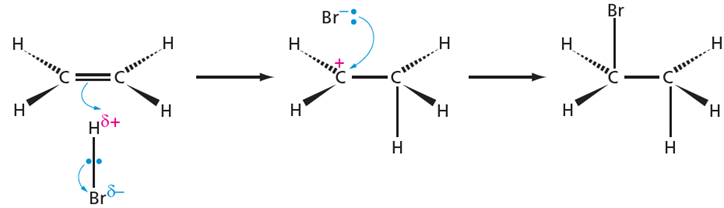
In the mechanism of addition, the H atom acts as the electrophile, accepting a pair of electrons from the C═C bond in the alkene.
the stability of primary, secondary and tertiary cations
Inductive effect
Markovnikov’s rule states that when HX adds to a double bond:
- The hydrogen atom attaches to the carbon that already has the most hydrogens, or
- The electrophile adds in the orientation that produces the most stable intermediate cation.
Where two addition products are possible, the major product is the one that has the halogen atom bonded to the C═C carbon atom with the highest number of alkyl groups bonded to it.
Intermediate: a species such as a carbocation, which is formed at a particular step of the reaction. Intermediates are stable enough to react with another substance but not stable enough to be products. They often have a partial positive or negative charge.
Addition of Steam
Oxidation
- by cold dilute acidified KMnO4 to form the diol
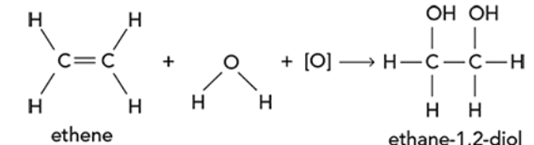
If an alkene is shaken with a dilute solution of acidified potassium manganate(VII), KMnO4(aq), at room temperature, the pale purple solution turns colourless. The alkene is converted into a diol, i.e. a compound with two alcohol (O─H) groups:
- by hot concentrated acidified KMnO4
Under these harsher conditions, the C═C double bond in the alkene is broken completely. The O─H groups in the diol formed initially are further oxidised to ketones, aldehydes, carboxylic acids or carbon dioxide gas. The actual products depend on what is bonded to the carbon atoms in the C═C double bond.